Call us USA (+1)312-698-3083
| Email : sales@wappnet.com

Predictive incident management flips the script: use data and AI to spot patterns that point to a future failure, then act before users are hit.
Most traditional incident management is reactive, whereas predictive incident management focuses on preventing failures before they impact users. A service degrades or fails, an alert fires, and an on-call engineer investigates, diagnoses, and remediates. The system is restored, a post-incident review is conducted, and the team moves on until the next incident. This cycle works, and it is the foundation of operational reliability for most organizations. The problem is that it is inherently backwards-looking: you respond to failures after they have already begun affecting users.
Predictive incident management represents a paradigm shift. Instead of waiting for a threshold to breach or a service to fail, predictive systems use historical and real-time operational data—metrics, logs, events, changes—to identify patterns that have historically preceded incidents and surface early warnings before the failure fully materializes. The goal is not to eliminate incidents entirely, which is impossible in any sufficiently complex system, but to catch a meaningful subset of them early enough that they can be prevented or mitigated before they escalate into user-facing outages.
This is not science fiction. It is applied machine learning on operational telemetry, and it is already deployed at scale by organizations managing large, complex infrastructure. The techniques are well understood, the tooling is maturing, and the business case is straightforward: fewer incidents, shorter incidents, and better use of engineering time. The challenge is not whether predictive incident management is possible; it is whether your organization has the data quality, the operational maturity, and the incident history required to make it work.
This document covers the full picture: what “predictive” actually means in this context, the five core AI techniques that power predictive capabilities, concrete examples of each, case studies from companies that have implemented predictive incident management at scale, the prerequisites you must have in place for prediction to deliver value, and an honest assessment of when the investment is justified and when it is premature.

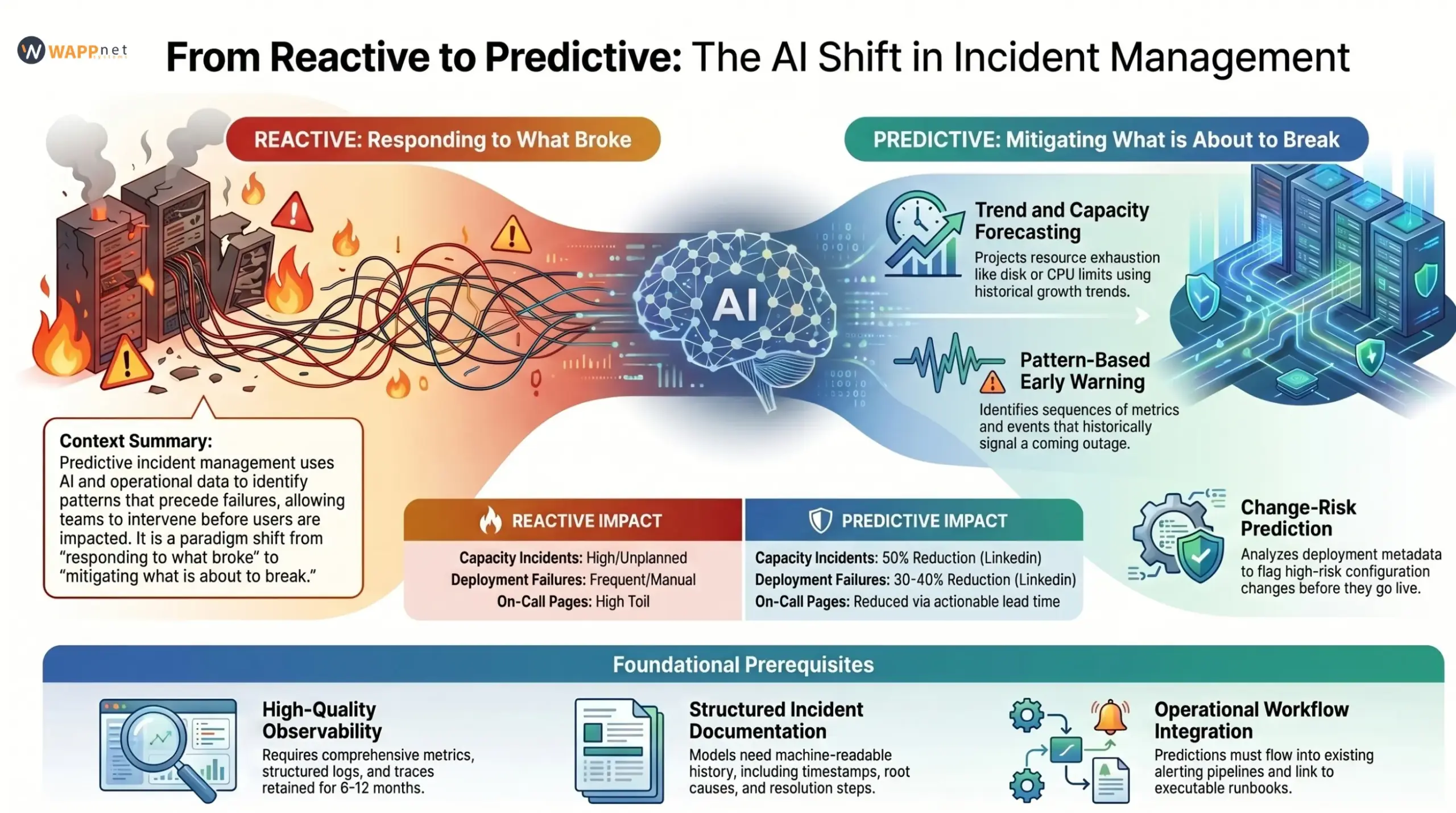
The difference between reactive and predictive incident management is not merely one of timing. It represents a fundamental shift in operational philosophy, from responding to known failures to anticipating probable failures based on pattern recognition.
| REACTIVE
Something breaks → alert fires → investigate → fix |
PREDICTIVE
Pattern/trend indicates risk → early warning → prevent or mitigate |
This approach is often referred to as predictive monitoring, where systems continuously analyze historical and real-time telemetry to forecast operational risk.In the context of incident management, predictive does not mean perfect foresight. It means that the system has learned, from historical data, which patterns of metrics, events, and changes have historically preceded incidents, and it surfaces early warnings when those patterns recur.
Prediction is probabilistic, not deterministic. A predictive alert that says the disk will be full in forty-eight hours is a forecast based on current usage trends. A warning that the current combination of anomalies has preceded outages in eighty percent of past cases is a risk assessment, not a guarantee.
The value proposition is pragmatic: if the system can flag thirty percent of incidents early enough for teams to act preventively, that is thirty percent fewer middle-of-the-night pages, thirty percent fewer user complaints, and thirty percent fewer postmortems discussing what went wrong. The other seventy percent still require reactive incident response, and that is acceptable. Prediction augments reactive capabilities; it does not replace them.
Predictive incident management is entirely dependent on data quality and completeness. Machine learning models learn from historical patterns, which means three things must be true for prediction to work. First, the system must have comprehensive telemetry: metrics from all critical services, structured logs capturing significant events, and traces showing request flow through the system.
Second, that telemetry must have sufficient historical depth: models need months or years of data to learn what normal looks like and to identify patterns that precede incidents. Third, incident data must be structured and labeled: when incidents occurred, which services were affected, what the root cause was, and what actions resolved them. This data-driven learning approach forms the backbone of AIOps predictive analytics, where operational data is transformed into proactive insights.
If any of these three foundations is weak—incomplete telemetry, shallow history, or poorly documented incidents—predictive capabilities will underperform or produce unreliable outputs. This is why the honest answer to when we should invest in predictive incident management is almost always after you have invested in solid observability and disciplined incident documentation, not before.
AI in incident management is not a single technology. Predictive incident management is not a single technology. It is an umbrella term for a set of techniques, each of which addresses a different aspect of anticipating and preventing incidents. The five core techniques are trend forecasting, pattern-based early warning, anomaly stacking and risk scoring, change-risk prediction, and recommended actions. Understanding each individually clarifies what is possible and what is required.
| Predictive Capability | What It Predicts | Key Data Required |
|---|---|---|
| Trend & capacity forecast | Resource exhaustion (disk, CPU, memory) | Historical metrics with clean trends |
| Pattern-based early warning | Incident-preceding metric patterns | Labeled incident history + pre-incident metrics |
| Anomaly stacking & risk score | Combined small anomalies indicating risk | Multiple correlated metrics per service |
| Change-risk prediction | High-risk deployments or config changes | Change data linked to incident outcomes |
| Recommended actions | What to do when prediction fires | Structured incident resolutions |
Trend forecasting is the most straightforward predictive technique and the one with the longest operational history. It applies statistical models or machine learning to time-series data to project when a resource will be exhausted or when demand will exceed capacity.
The canonical example is disk space: if a volume is currently at sixty percent utilization and has been growing at two percent per week for the past six months, a simple linear projection predicts it will reach ninety percent in twelve days, giving the team time to provision additional capacity or clean up old data before an incident occurs.
Capacity forecasting extends this to other resources: CPU, memory, database connections, API rate limits, and network bandwidth. The value is highest for resources where exhaustion causes hard failures and where provisioning or cleanup takes time. This is a core capability delivered through modern AI development services, enabling teams to act preventively rather than reactively.
Pattern-based early warning is more sophisticated than simple trend forecasting. It identifies sequences of metrics and events that have historically preceded incidents, even when no individual metric has breached a threshold. The insight is that many incidents do not happen suddenly; they are preceded by a period of gradual degradation that is visible in the data but that individual threshold-based alerts miss.
For example, an outage might be preceded by a slow increase in API latency, a slight uptick in database query times, and a few isolated errors—none of which individually crosses an alert threshold, but which together form a pattern that has preceded outages in the past. A pattern-based early warning system recognizes this signature and raises an alert before the situation escalates.
Anomaly stacking combines multiple small anomalies—none of which would individually trigger an alert—into a composite risk score. The premise is that a single anomaly may be noise, but multiple concurrent anomalies across related metrics or services are a stronger signal of emerging problems.
For instance, if a service shows slightly elevated CPU usage, slightly higher memory consumption, and a small increase in error rate, each individual anomaly might be below the threshold for alerting. But together, they may indicate that the service is under stress and at elevated risk of failure. Anomaly stacking produces a single risk score that captures this composite signal, allowing teams to investigate proactively rather than waiting for a threshold breach.
Change-risk prediction addresses one of the most common root causes of production incidents: deployments and configuration changes. By analyzing historical data linking changes to incidents, the system learns which types of changes and which contexts are high risk, and it flags upcoming changes that match high-risk patterns.
For example, if database schema changes have historically caused incidents thirty percent of the time, and a new schema migration is scheduled, the system flags it as high risk and suggests additional safeguards: extra pre-deployment testing, a staged rollout with canary analysis, or increased monitoring during and after the deployment. Low-risk changes—minor configuration updates, routine dependency upgrades—proceed with standard procedures.
Read More: How AI Reduces Downtime: From Detection to Recovery
Predictive alerts without actionable guidance are only marginally better than reactive alerts. The fifth core technique is connecting predictions to recommended actions based on past incident resolutions. When a prediction fires, the system suggests what to do: which runbook to consult, which team to notify, and which remediation steps have been successful in similar past cases.
For example, a prediction that a disk will be full in forty-eight hours should include recommendations: extend the volume, archive old logs to cheaper storage, or delete temporary files. A prediction that the current metric pattern has preceded outages in the past should link to the postmortems from those incidents, showing what the root cause was and what actions resolved it.
Predictive capacity management and deployment risk scoring at scale
LinkedIn operates a globally distributed social network with hundreds of millions of active users and thousands of microservices. In published engineering blog posts, LinkedIn describes deploying predictive capacity forecasting that analyzes historical traffic patterns, seasonal trends, and growth rates to project when services will exceed capacity thresholds. These forecasts feed into automated capacity planning workflows, provisioning additional compute and storage resources days or weeks before they are needed, eliminating reactive capacity incidents.
LinkedIn also implemented change-risk scoring for deployments: each deployment is assigned a risk score based on historical data about similar changes, the services being deployed, the time of day, and current system load. High-risk deployments trigger additional pre-deployment checks, extended canary periods, and increased post-deployment monitoring. Low-risk deployments proceed with standard automation. LinkedIn credits these predictive capabilities with reducing capacity-related incidents by an estimated fifty percent and deployment-related incidents by thirty to forty percent. The key enabler was disciplined incident documentation: every incident is logged with structured metadata about affected services, root cause, and resolution, providing the training data the models require.
Predictive incident management is not plug-and-play. It requires significant foundational investment before the predictive layer can deliver value. The following prerequisites are non-negotiable. Attempting to deploy predictive capabilities without them will produce unreliable outputs that erode trust and waste resources.

Prediction depends entirely on the data it learns from. If your metrics collection is incomplete, if logs are unstructured, or if distributed tracing is absent, the models will have blind spots. Services that are not instrumented cannot be included in predictions.
Metrics that are noisy or inconsistent will produce unreliable forecasts. The first investment is always in observability: instrumenting all critical services, standardizing log formats, and ensuring traces are captured for important request paths—an approach typically implemented through advanced AI development services.
Machine learning models learn by correlating incidents with the metrics, events, and changes that preceded them. This requires that incidents be documented in a structured, machine-readable format. Every incident should have a timestamp, a list of affected services, a root cause category, a timeline of significant events, and a description of the resolution. Unstructured postmortems stored in wikis or shared documents are useful for humans but not for training predictive models.
Predictive systems require ongoing tuning, monitoring, and governance. Someone must own the models: reviewing prediction accuracy, investigating false positives and false negatives, retraining models as the system evolves, and deciding when predictions warrant action or automation. Without clear ownership, predictive capabilities drift out of alignment with operational reality and lose the trust of the teams they are meant to help.
Predictions that exist in a separate tool that operators do not look at will not prevent incidents. For predictive capabilities to be effective, they must be integrated into the alerting, incident management, and runbook systems that teams use every day.
Predictive alerts should flow through the same alerting pipeline as reactive alerts, with the same routing and escalation logic. Predictions should populate incident tickets automatically, and recommended actions should link to executable runbooks.
The business case for predictive incident management is direct: fewer incidents, shorter incidents, and better use of engineering time translate into revenue protection, improved customer satisfaction, and operational efficiency.
The most visible benefit of predictive incident management is a reduction in the number of incidents that reach production. When capacity forecasts trigger proactive provisioning, disk-full incidents do not occur.
When pattern-based early warnings allow teams to investigate and mitigate before escalation, full outages are avoided. When high-risk deployments receive extra scrutiny, deployment-induced incidents decrease. Even a ten to twenty percent reduction in incident volume compounds into significant savings in engineering time, on-call burden, and customer impact.
Predictions do not always prevent incidents entirely, but they often reduce severity. An incident that is detected and mitigated while still affecting only a small percentage of traffic is less damaging than one that affects all users.
Early warnings give teams time to implement partial mitigations—graceful degradation, traffic rerouting, and feature flags—that limit blast radius. The business impact of a severity-two incident is materially lower than a severity-one incident, and shifting the distribution toward lower-severity incidents protects both revenue and reputation.
This shift is central to modern AI-powered IT operations, enabling teams to move from reactive firefighting to proactive resilience engineering. On-call teams that spend less time responding to incidents and more time on preventive work—improving observability, refining runbooks, and conducting architecture reviews—are more effective and more satisfied.
Predictive capabilities reduce toil by eliminating entire classes of reactive work: no more midnight pages for predictable capacity issues, and no more emergency rollbacks for high-risk deployments that should have been flagged in advance. This efficiency allows the same team to support more services or allows the organization to grow its infrastructure footprint without proportionally growing the operations headcount.
Predictive insights improve cross-team coordination. When capacity forecasts indicate that a service will require additional infrastructure in three weeks, the team has time to plan the provisioning, schedule maintenance windows, and communicate with dependent teams.
When change-risk scoring identifies a high-risk deployment, the team can coordinate with stakeholders, increase monitoring coverage, and prepare rollback procedures in advance. This structured approach to risk management is more efficient and less disruptive than reactive firefighting.
MEASURABLE OUTCOM
✓ Reduction in incident count—measured as percentage decrease over a baseline period.
✓ Reduction in severity of one incident—measured as absolute count or percentage decrease.
✓ Reduction in on-call pages—measured as pages per engineer per week or month.
✓ Increase in lead time for capacity provisioning—measured in days or weeks of advance notice.
✓ Reduction in deployment-related incidents—measured as percentage of deployments that cause incidents.
Predictive alerting and proactive capacity management at planetary scale
Google’s Site Reliability Engineering teams manage infrastructure and services at a scale where reactive incident management is infeasible. In published SRE books and conference talks, Google describes using predictive models for capacity forecasting that project resource exhaustion weeks or months in advance, allowing automated provisioning systems to scale infrastructure proactively. Google also uses anomaly detection and pattern recognition to identify pre-incident signals: combinations of metrics and events that have historically preceded outages.
These early warnings trigger automated canary rollbacks, traffic rerouting, or alerts to engineering teams, often preventing incidents before they fully materialize. Google emphasizes that predictive systems are deployed incrementally: start with forecasting and early warning for well-understood failure modes, measure impact rigorously, and expand only when the system proves reliable. The cultural enabler is that Google treats prediction errors—both false positives and false negatives—as high-priority learning opportunities, ensuring that models continuously improve based on operational feedback.
The decision to invest in predictive incident management should be driven by a clear assessment of your organization’s operational maturity, data quality, and incident characteristics. The following framework provides structured criteria for evaluating readiness.
Predictive incident management using AI represents a shift from reactive firefighting to proactive risk mitigation. By applying machine learning to operational telemetry—metrics, logs, events, and changes—predictive systems identify patterns that have historically preceded incidents and surface early warnings before failures fully materialize. The five core techniques—trend forecasting, pattern-based early warning, anomaly stacking, change-risk prediction, and recommended actions—each address different aspects of anticipation and prevention.
The business case is straightforward: fewer incidents, shorter incidents, and better use of engineering time. The prerequisites are equally clear: comprehensive observability, disciplined incident documentation, clear ownership and governance, and integration with operational workflows. Prediction is not a substitute for good engineering; it is an amplifier for teams that have already built a solid operational foundation.
The pragmatic path is incremental adoption. Start with the techniques that address your highest-pain areas: capacity forecasting if resource exhaustion is a recurring problem, and change-risk scoring if deployments are a frequent root cause.
Measure impact rigorously. Expand only when the system proves reliable and delivers measurable value. Keep humans in control of high-stakes decisions and treat prediction as a tool that augments human judgment, not one that replaces it. Organizations working with an experienced AI development company can accelerate the implementation of predictive models and operational integration.
Predictive incident management is the use of machine learning and operational data to forecast potential system failures before they impact users. Unlike reactive monitoring, it identifies patterns and risk signals in advance, enabling preventive action.
AI in incident management prevents outages by analyzing historical metrics, logs, deployment patterns, and anomalies to identify early warning signals. Through predictive monitoring and risk scoring, teams can mitigate issues before they escalate into production failures.
For organizations with recurring incidents and sufficient telemetry data, predictive monitoring delivers measurable ROI. It reduces incident frequency, lowers severity levels, and improves operational efficiency—making it a key pillar of modern AI-powered IT operations and AIOps predictive analytics strategies.