Call us USA (+1)312-698-3083
| Email : sales@wappnet.com

PostgreSQL is a robust, open-source object-relational database system. Hence, it extends the SQL language. Besides, it has several capabilities for storing and scaling the most complex data. It has a reputation for established design and data integrity. Likewise, its broad feature set delivers creative solutions. Likewise, it is compatible with all major operating systems. And, many organizations use Postgre SQL development as their open-source relational database.
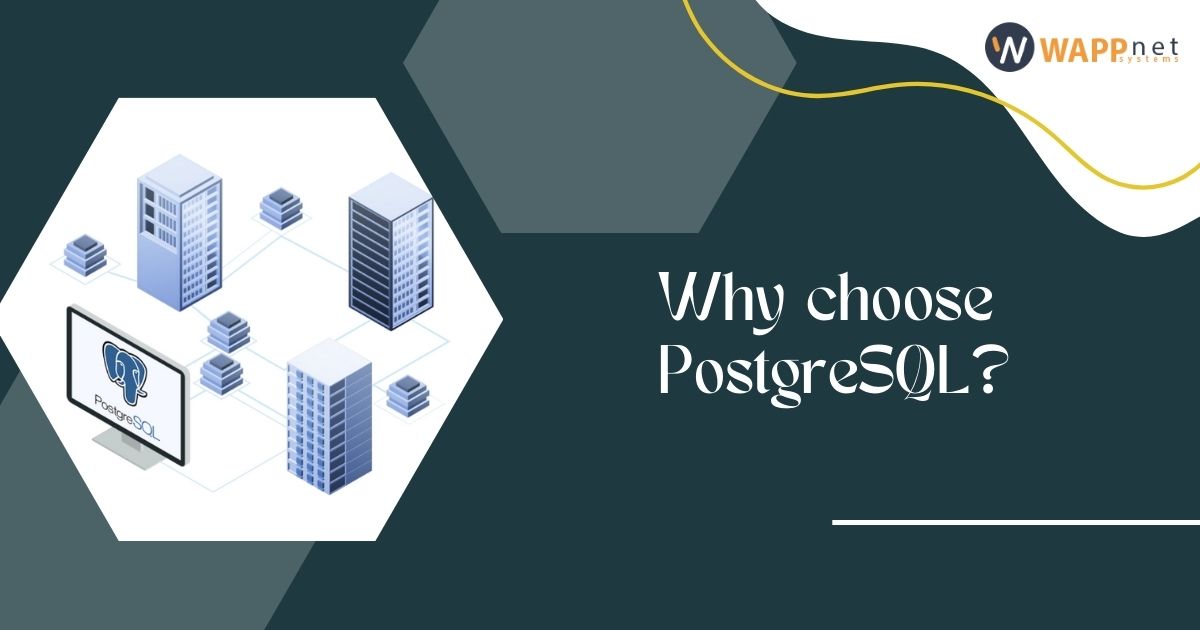
Postgresql development tools include several capabilities designed to assist developers. Thus, these help in building applications. Besides, it aids administrators in protecting data integrity. They can build fault-tolerant settings and manage your data. And, it is regardless of how large or small the data is. Besides, being free and open-source, PostgreSQL is very extendable. You may, for example, establish your own data types and create custom functions. Also, one can even code in other languages without having to recompile the database!
While being free and open-source, PostgreSQL is very extendable. When it comes to database configuration, it excels in two areas. First, it complies with SQL standards to a high degree. This improves its compatibility with other programs. Second, it provides users with metadata control. PostgreSQL differs from traditional relational database systems in its catalogs. It supports information about tables and columns. Yet, it can also contain information about data types, functions, and so on.
These capabilities are strong tools. These allow you to deal with your databases using ways that you may be familiar with. Thus, because of the extra flexibility, you may represent many types. Likewise, it is within the database system rather than outside of your applications. This can aid in maintaining consistency. And, it enforces desired behavior closer to the data.
PostgreSQL has a long history of supporting sophisticated data types and delivering performance optimizations often associated with commercial database systems. Many modern applications rely on PostgreSQL as their primary data storage solution. It can efficiently handle both structured and unstructured data such as audio, video, emails, and social media posts. This capability helps businesses enhance customer service, uncover new product requirements, and identify strategies to improve customer retention.
For organizations dealing heavily with flexible or rapidly changing datasets, modern NoSQL solutions like MongoDB for unstructured business data are often considered alongside PostgreSQL. MongoDB enables businesses to store and process large volumes of unstructured information efficiently, making it suitable for real-time analytics, content-heavy applications, and evolving data models.
PostgreSQL can also be configured for automated failover and redundancy, making it a strong choice for financial institutions and enterprise environments. Additionally, it functions as a powerful analytical database and integrates well with mathematical tools such as MATLAB and R. Websites and applications can scale horizontally across multiple database servers to support growing data demands.
It can operate dynamic web applications. Because of its write-ahead logging, it is a fault-tolerant database. Also, the source code is accessible under an open-source license. Hence, this gives you the ability to use, adapt, and apply it as needed for your business. Also, it allows for location-based services. It also provides geographic information systems since it supports geographic objects. Additionally, it requires less training to learn because it is simple to use. Finally, it requires less maintenance. And, it is easy to manage for embedded and business applications.
The PostgreSQL developer's job has expanded in recent years. Hence, even large organizations have at least one PostgreSQL engineer on their team. Spotify and Instagram are a few examples. So, what exactly does a professional engineer do? The programmer is in charge of the product's creation. And, they also take care of product integration and further quality control.
PostgreSQL supports a broader and more advanced range of data types compared to MySQL, making it a stronger choice for complex applications and systems that require high flexibility. If your application relies on specialized or unstructured data, PostgreSQL often provides better scalability and extensibility. However, both databases perform well when dealing with standard character and numeric data types, making them suitable for general use cases.
On the other hand, MySQL for web database management remains a popular choice for many developers due to its simplicity, ease of setup, and strong performance in traditional web applications. It is widely used in content-driven websites and applications where straightforward relational data handling is required.
Ultimately, the choice between PostgreSQL and MySQL depends on your application needs, data complexity, and scalability requirements.