Call us USA (+1)312-698-3083
| Email : sales@wappnet.com
Mobile applications have transformed well beyond their rudimentary functionality and have found their place at the core of how businesses create value, engage users, and grow digitally. Mobile app development is now not merely about the construction of applications but also about developing smart, scalable ecosystems that meet user expectations.
By 2026, the advent of AI-based interfaces, cross-platform frameworks, and cloud-native infrastructure is reshaping the way businesses consider digital products. All current mobile application development firms are orienting themselves toward delivering progressive, scalable experiences beyond ordinary app functionality.
Smart mobile app solutions are becoming increasingly popular in organizations as they aim to enhance performance, personalization, and long-term growth.
Key Takeaways

Mobile app development technologies refer to the frameworks, programming languages, tools, and architectures that are employed to create applications on various platforms like Android, iOS, and the web.
These technologies characterize the functionality, scalability, and interaction of applications with contemporary systems. An effective mobile app development firm integrates various tools and frameworks to deliver efficient and future-proof applications that are responsive to business requirements.
Choosing an appropriate technology stack is very important in determining the success of an application. It directly affects performance, scalability, maintenance, and general user experience.
Companies investing in the correct strategy can develop digital products that perform well, whereas poor choices can result in higher expenses and technical constraints. Understanding the benefits of mobile apps for businesses helps organizations make informed technology decisions and invest in scalable mobile app solutions that support long-term growth.
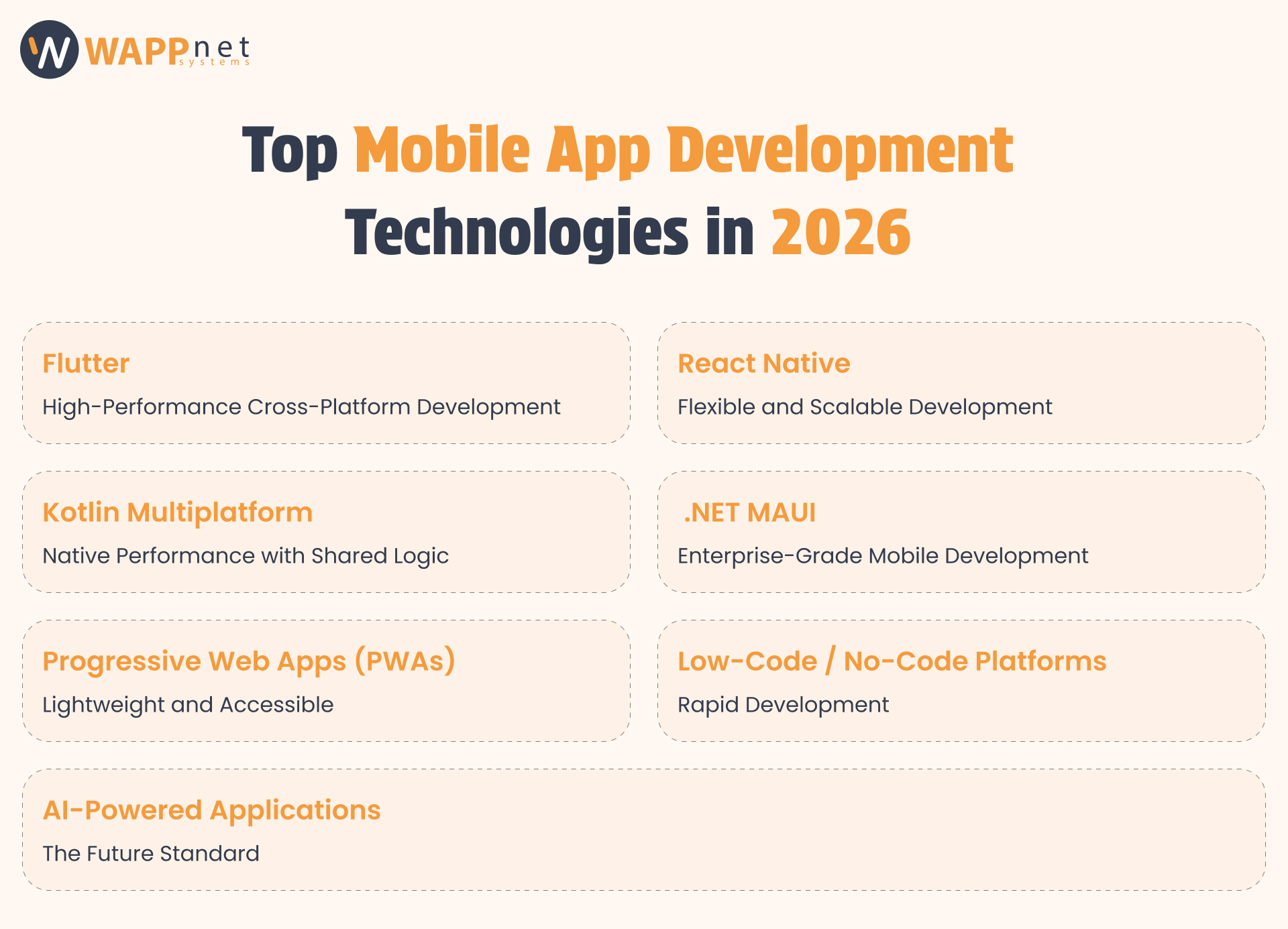
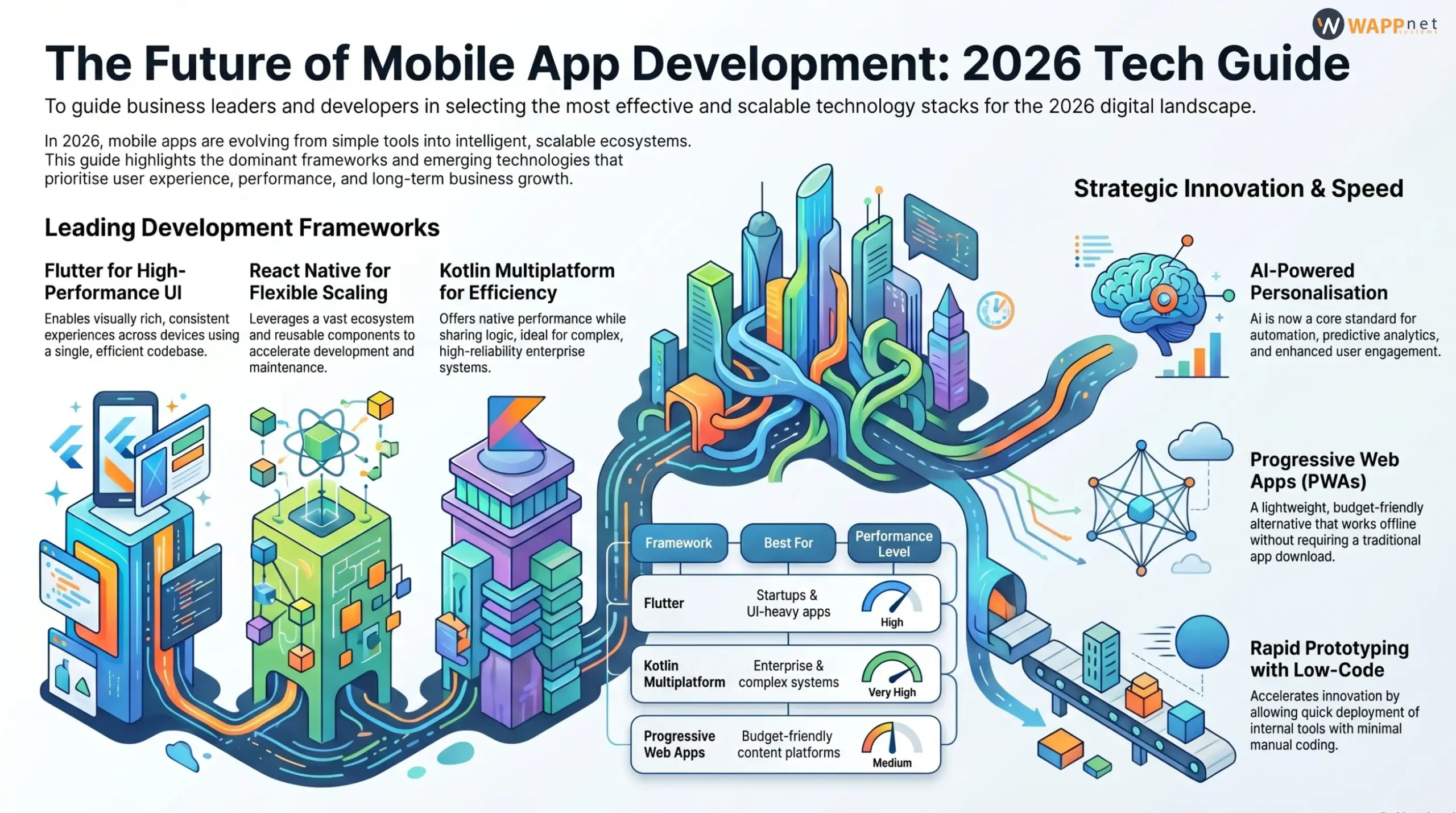
1. Flutter: High-Performance Cross-Platform Development
Flutter is now one of the most popular cross-platform frameworks for developing applications. It enables developers to develop high-performance and rich visual apps with one code base.
Its capability of creating customized UI components makes it consistent across devices, and it is a preferred option for businesses that value design and speed in business.
2. React Native: Flexible and Scalable Development
React Native remains a popular technology because of its flexibility and powerful ecosystem. It is developed in JavaScript and is supported by many of the best React Native development tools, enabling faster development, easier maintenance, and improved scalability for modern applications.
The reusable nature and large community support are advantageous to companies since they aid in speeding up development cycles and complexity reduction.
3. Kotlin Multiplatform: Native Performance with Shared Logic
Kotlin Multiplatform offers a middle ground by enabling shared code and native performance. This is because it is best suited for high-efficiency and reliable applications.
It is being adopted more in enterprise environments where performance and scalability are a crucial consideration.
4. .NET MAUI: Enterprise-Grade Mobile Development
.NET MAUI is designed to develop applications across various platforms using a single codebase. It is compatible with enterprise systems and offers high security and performance.
This renders it an appropriate option in large-scale applications in need of stability and long serviceability.
5. Progressive Web Apps (PWAs): Lightweight and Accessible
Progressive Web Apps provide a hybrid experience of web and mobile. They can be accessed using browsers and come with functions such as offline presence and push notifications.
They can be particularly helpful for companies that strive to connect with more people without requiring them to download an app.
6. Low-Code / No-Code Platforms: Rapid Development
Application development is becoming quicker and more accessible through low-code and no-code platforms. The tools enable users to create applications with little knowledge of coding.
They are best suited to rapid prototyping, internal tools, or quick deployments and can assist businesses in innovating more quickly.
7. AI-Powered Applications: The Future Standard
AI is a fundamental part of contemporary applications. It allows applications to be personalized, automated, and predictive, which enhances the user experience.
Through chatbots and recommendation systems, AI-based capabilities have become a requirement for producing competitive digital products.
To choose the right technology, it’s important to understand how the leading frameworks differ in terms of performance, scalability, and use cases.
| Framework | Type | Best For | Performance Level | Key Advantage |
| Flutter | Cross-platform | Startups, MVPs, UI-heavy apps | High | Fast development with rich UI |
| React Native | Cross-platform | Scalable apps, web-based teams | High | Reusable code and strong ecosystem |
| Kotlin Multiplatform | Hybrid (Native + Shared) | Enterprise apps, complex systems | Very High | Native performance with shared logic |
| .NET MAUI | Cross-platform | Enterprise & Microsoft ecosystem | High | Strong integration with Microsoft tools |
| Progressive Web Apps (PWA) | Web-based | Budget apps, content platforms | Medium | No installation required |
| Low-Code Platforms | Visual Development | MVPs, internal tools | Medium | Rapid development and low cost |
The sector is shifting to more interconnected and smarter ecosystems. The use of technologies such as 5G, IoT, and cloud computing is enabling more responsive and faster applications.
Security and data privacy are also taking a leading role and compelling businesses to implement stronger and more secure architectures.
The selection of the appropriate approach depends on business objectives, user expectations, and technical needs. Organizations need to consider scalability, performance, and long-term adaptability before making a choice.
When collaborating with the appropriate mobile app company, it ensures access to professional knowledge and assistance in creating efficient digital products in accordance with business aims.
In mobile app development in 2026, the need to focus on innovation, scalability, and user-centricity is emphasized. To stay relevant and provide meaningful digital experiences, businesses need to embrace the use of modern technologies.
Using the right tools and strategies, companies can create future-ready applications that are not only functional but also scalable. The future of the business in a more digitalized environment is in investing in high-quality technologies and partners that can be trusted.
What is Mobile App Development (2026)?
Mobile app development can be defined as the creation of scalable, user-friendly applications based on the most recent frameworks, such as Flutter, React Native, and AI-based solutions.
Why hire a mobile app development company?
They offer experience, quicker implementation, and scaled solutions depending on the business requirements.
What are mobile app solutions?
They are end-to-end services comprising the design, development, deployment, and maintenance of applications.
Which technology is best in 2026?
It depends on your business goals and technical requirements. Popular options include React Native and Flutter for cross-platform mobile app development, along with AI-powered solutions for intelligent user experiences.