Call us USA (+1)312-698-3083
| Email : sales@wappnet.com

The question is not which is better. It is what we need now, and where does AI actually help versus where does it just add cost and complexity?
If you have been in operations or site reliability for any length of time, you have lived the shift. Early in your career, monitoring meant checking if the server responded to a ping and reading log files manually. Then dashboards arrived: Grafana panels showing CPU and memory, with alert rules firing when a threshold was crossed. Then came distributed tracing, structured logging, and the explosion of metrics that came with microservices and cloud infrastructure.
Traditional monitoring brought us here: metrics collected by agents, logs centralized in a search platform, traces captured to understand request flow, and thresholds set by humans who decide what constitutes normal and what constitutes an incident. It works. It is predictable, explainable, and mature. The problem it does not solve well is scale and context: when you have hundreds of services, thousands of metrics, and deployments happening multiple times per day, the volume of data and the speed of change outpace what a human can tune and correlate.
AIOps—Artificial Intelligence for IT Operations—is the industry’s answer to that gap. It applies machine learning to the data that traditional monitoring already collects and attempts to detect anomalies without fixed thresholds, correlate related events automatically, suggest root causes based on historical patterns, and reduce alert noise. It is not a replacement for traditional monitoring. It is a layer on top, meant to augment human operators rather than supplant them. This is where AIOps vs Traditional Monitoring becomes a strategic decision for modern Site Reliability Engineering (SRE) monitoring teams.
This document covers the full picture: what traditional monitoring does well and where it struggles, what AIOps adds and where it introduces new trade-offs, a side-by-side comparison across real operational scenarios, case studies from companies that have adopted AIOps at scale, and a practical decision framework for when the investment is justified.

Traditional monitoring is the foundation that almost every engineering organization runs on today. It is composed of four core pillars, each with mature tooling and well-understood operational patterns.
Metrics are numeric measurements collected at regular intervals: CPU utilization, memory usage, request rate, error count, and latency percentiles. Agents running on hosts or within applications export these metrics to a time-series database such as Prometheus, InfluxDB, or a managed service like Datadog or AWS CloudWatch. Operators define what to collect, at what granularity, and for how long to retain it.
The strength of metrics is their structured simplicity. A metric has a name, a timestamp, a value, and optionally a set of labels. Querying is fast, aggregation is straightforward, and visualization in dashboards is well supported. The weakness is that metrics alone do not tell you why something happened, only that it did.
Logs are unstructured or semi-structured text emitted by applications and infrastructure components. Centralized logging platforms such as Elasticsearch (part of the ELK stack), Splunk, or Grafana Loki collect, index, and make logs searchable. When an incident occurs, operators search logs for error messages, stack traces, or evidence of what went wrong.
The strength of logs is context: they capture the detail that metrics cannot. The weakness is volume and search cost. High-traffic systems produce gigabytes or terabytes of logs per day, making it expensive to store and slow to search without careful indexing and retention policies.
Traces capture the path of a request as it travels through a distributed system, showing which services were called, in what order, and how long each step took. Tools like Jaeger, Zipkin, or vendor-provided tracing (Datadog APM, AWS X-Ray) allow operators to visualize the entire request lifecycle and identify bottlenecks or failures.
The strength of tracing is end-to-end visibility. The weakness is adoption cost: instrumenting every service, managing trace sampling rates to control volume, and training teams to use traces effectively all require upfront investment.
Alerts are rules that fire when a condition is met: if the error rate exceeds five percent for five consecutive minutes, page the on-call engineer. Alerts are routed to the appropriate team via PagerDuty, Opsgenie, or equivalent, and the on-call engineer consults dashboards, logs, and runbooks to diagnose and resolve the issue.
The strength of threshold-based alerting is clarity. Everyone understands what triggered the alert and what the condition was. The weakness is tuning: too sensitive and you drown in false positives; too lenient and you miss real incidents. Maintaining thresholds as the system grows and changes is ongoing manual work.
Read More: Mobile App Deployment Automation: Ship Faster Without the Store Friction

AIOps does not replace the metrics, logs, traces, and alerts that traditional monitoring provides. Instead, it consumes them as input and applies machine learning, statistical analysis, and automation to provide capabilities that are difficult or impossible to achieve with static rules.
Anomaly detection uses statistical models or machine learning to learn what normal behavior looks like for a given metric and flag deviations from that baseline. Instead of setting a rule that says the error rate must not exceed five percent, the system observes that the error rate is typically between zero-point-five and one-point-five percent during business hours and flags a spike to three percent as anomalous, even though it is below the hard threshold.
This is particularly valuable for metrics that normally change over time: traffic grows, seasonal patterns emerge, and new features shift user behavior. A static threshold either becomes outdated quickly or is set so conservatively that it loses sensitivity. An adaptive baseline, by contrast, adjusts as the system evolves.
When a deployment goes wrong, it may trigger alerts across multiple services: latency increases in the API gateway, error rates climb in the database service, and CPU spikes on several backend nodes. Traditional monitoring fires each alert independently. AIOps platforms attempt to group these related alerts into a single incident, reducing the cognitive load on the on-call engineer and making it immediately clear that these are symptoms of a single root cause.
Correlation works by analyzing temporal proximity (alerts that fire within minutes of each other), topology (services that call each other), and similarity (alerts with similar patterns in their triggering metrics). When correlation is effective, it transforms a wall of alerts into a structured incident timeline.
AIOps platforms that have access to historical incident data can suggest likely root causes for new incidents based on pattern matching. If past incidents with a similar metric profile and alert sequence were caused by a specific type of deployment or infrastructure failure, the system surfaces that as a hypothesis for the current incident.
This does not replace human investigation, but it accelerates triage. Instead of starting from scratch, the on-call engineer begins with a shortlist of probable causes and can confirm or rule them out more quickly than a blind search through logs and traces.
AIOps systems can suppress duplicate alerts or alerts that are downstream consequences of a root incident that has already been identified. For example, if a database failure is detected and an incident is created, alerts from application services that depend on that database can be automatically suppressed or downgraded because the operator already knows the root cause and does not need redundant notifications.
This is particularly valuable in large, distributed systems where cascading failures produce dozens or hundreds of alerts. Effective noise reduction means the on-call engineer receives one critical alert instead of fifty and can focus on remediation instead of sorting through redundant information.
Some AIOps platforms support automated remediation: if a known failure pattern is detected, the system can trigger a predefined response such as restarting a service, scaling up capacity, or rolling back a deployment. This is the most advanced and the most risk-laden capability that AIOps offers.
Automation works well when the failure mode is well understood, the remediation is low risk, and there are adequate guardrails to prevent runaway actions. It works poorly when the failure is novel, the system state is ambiguous, or the automation lacks sufficient context to choose the correct action. Most organizations that use automated remediation start conservatively, allowing automation only for specific, low-risk scenarios and keeping a human in the loop for everything else.
Adaptive alerting and automated response at planetary scale
Google’s SRE teams operate services at a scale where manual threshold tuning is infeasible. In published SRE books and conference talks, Google describes using statistical models to set dynamic alert thresholds based on historical behavior and seasonal patterns and deploying automated canary analysis to catch regressions during rollouts before they reach all users.
Their approach emphasizes gradual rollout of automation: start with alerting suggestions that humans can ignore, move to automated responses for low-risk scenarios, and keep kill switches accessible so that humans can override automation when it misbehaves. The key lesson from Google’s experience is that AIOps-style intelligence is a force multiplier for operations, but only when it is deployed incrementally, with strong observability into the automation itself, and with a culture that treats automation failures as high-priority learning opportunities.
The practical question in AIOps vs Traditional Monitoring is not which paradigm is superior in the abstract, but which is the right tool for a given operational scenario.
The table below maps common operational needs to the monitoring approach that handles them best.
| Use Case | Traditional Monitoring | AIOps |
|---|---|---|
| Basic health checks | Ideal — clear metrics & thresholds | Optional — can add anomaly layer |
| 50 alerts at once | Manual correlation across tabs | Auto-correlation & grouping |
| Traffic pattern changes | Update thresholds or false positives | Baseline adapts automatically |
| Root-cause analysis | Human-driven via logs & traces | Suggests likely causes from history |
| Alert noise reduction | Manual tuning & suppression | Deduplication & correlation |
| Predict before it breaks | Hard with static thresholds | Anomaly & trend-based alerts |
| Full explainability | Every rule is transparent | Model behavior less transparent |
| Low cost & complexity | Mature, well-understood | Higher cost & integration work |
Traditional monitoring remains the correct choice for teams with a small to medium number of services, well-understood traffic patterns, and the operational capacity to maintain thresholds and runbooks manually. It is also the correct choice when explainability and direct control are paramount: in regulated industries, in safety-critical systems, or in organizations where the cost of a false positive (an unnecessary page) is lower than the cost of a false negative (a missed incident).
AIOps becomes justifiable when the volume and complexity of the system exceed what a human operator or a small ops team can manage with traditional tooling. Specifically: when alert fatigue is a persistent problem despite ongoing tuning efforts, when correlation and root-cause analysis consume a disproportionate amount of incident response time, when traffic patterns change frequently enough that static thresholds require constant updates, or when the organization is willing to invest in the tooling, integration work, and process discipline required to operate AIOps effectively.
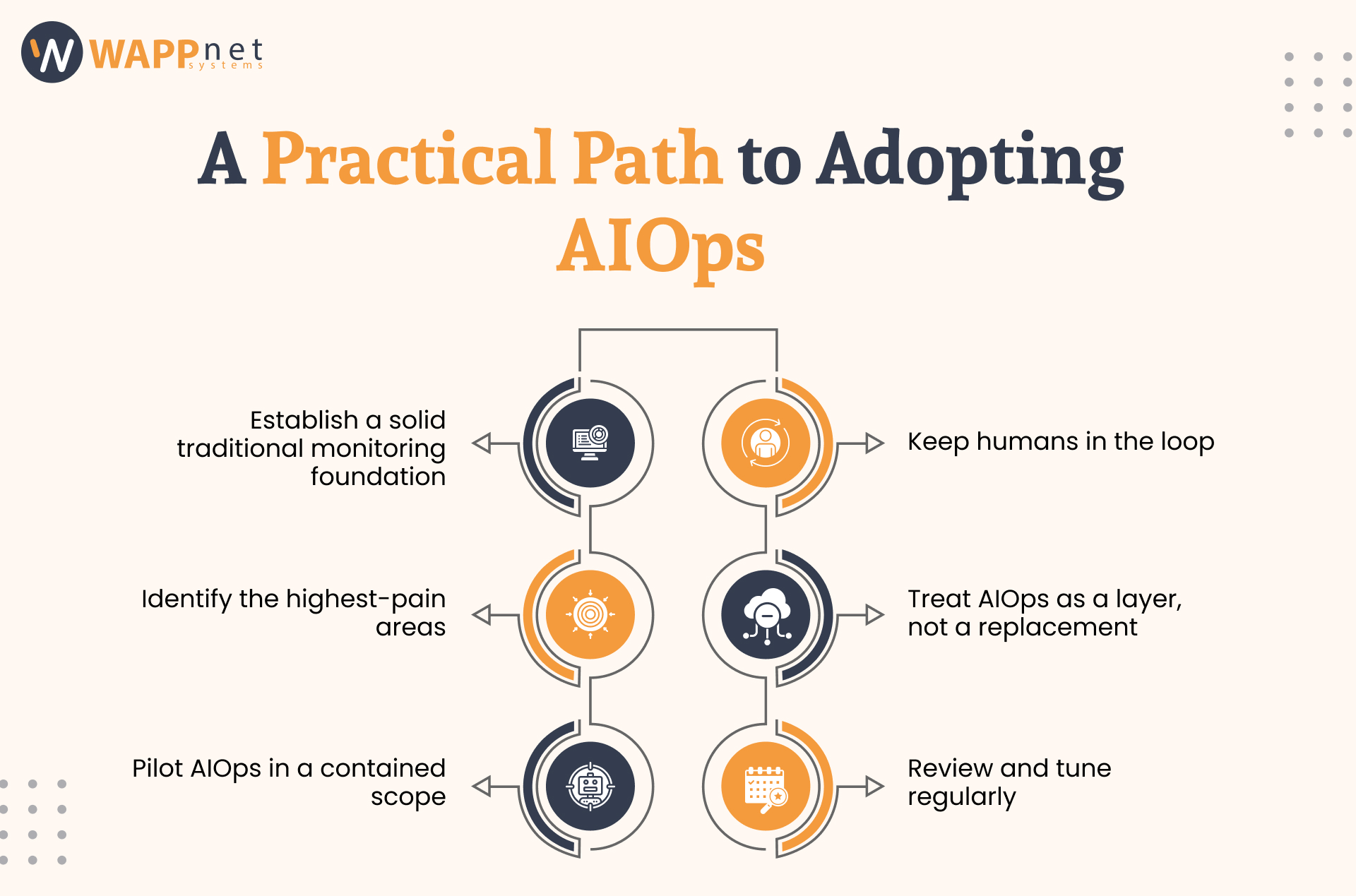
AIOps is not an all-or-nothing decision. The pragmatic path is incremental adoption, starting with the areas where traditional monitoring struggles most and expanding only after demonstrating value.
If your organization is evaluating structured adoption, consider working with specialists in AIOps Implementation & Consulting Services to ensure proper platform integration, governance, and measurable ROI across your IT operations automation initiatives.
Incremental AIOps adoption to reduce alert fatigue across hundreds of microservices
Capital One’s cloud engineering teams manage hundreds of microservices deployed across multiple regions. In public engineering talks, they describe facing severe alert fatigue: too many alerts, too many false positives, and an inability to tune thresholds fast enough to keep up with growth and deployment velocity. Their AIOps adoption followed an incremental path: they started with anomaly detection on a small subset of critical metrics for one product line, measured the reduction in false positives and the improvement in time-to-detect, and used that success to build executive support for broader rollout.
The key enabler was strong partnership between the SRE team (who understood operations) and the data science team (who understood machine learning), ensuring that models were tuned for operational relevance rather than algorithmic novelty. The result was a measurable reduction in alert volume and an increase in operator confidence that high-priority alerts represented real incidents.
The decision to invest in AIOps should be driven by a clear-eyed assessment of the problems you are trying to solve and whether AIOps platform integration will deliver measurable improvements in intelligent incident management, alert noise reduction, and overall operational efficiency.
READINESS CHECKLIST
✓ Do you have high-quality, complete metrics, logs, and traces across all critical services?
✓ Have you exhausted reasonable improvements to threshold tuning, alert grouping, and runbook quality?
✓ Is alert fatigue or correlation overhead a measurable drag on incident response time?
✓ Do you have sufficient historical data (months to years) for a model to learn from?
✓ Are you prepared to invest in platform licensing, integration work, and ongoing tuning?
Traditional monitoring—metrics, logs, traces, thresholds, dashboards, and alerts—is the foundation. It is reliable, explainable, mature, and well understood. It works. The limitation is scale and context: as the number of services grows, as deployment velocity increases, and as traffic patterns shift, the volume of data and the speed of change outpace what human operators can tune and correlate effectively.
AIOps is a layer on top of traditional monitoring that applies machine learning and automation to detect anomalies without fixed thresholds, correlate related alerts into single incidents, suggest root causes from historical patterns, reduce noise through deduplication, and, in some cases, trigger automated remediation. It is not a replacement for traditional monitoring; it is an augmentation meant to handle the scale and complexity that static rules cannot.
The decision to adopt AIOps should be driven by a pragmatic assessment of where traditional monitoring is failing and whether the investment in AIOps tooling, integration, and process will deliver measurable improvements in time-to-detect, time-to-resolution, and operator quality of life. Start with a strong traditional monitoring foundation, identify the highest-pain operational areas, pilot AIOps in a contained scope, keep humans in the loop, and expand only after demonstrating value.
The goal is not to chase AI for its own sake. The goal is to run systems reliably at scale, reduce toil, and allow operators to focus on the work that only humans can do: understanding complex failure modes, making judgment calls under uncertainty, and building systems that are resilient by design. AIOps is one tool in the service of that goal. Use it where it helps, and do not use it where traditional monitoring is sufficient.