Call us USA (+1)312-698-3083
| Email : sales@wappnet.com

Ask most operations managers at a UK field service company whether their software is good enough, and you’ll usually get a shrug. The scheduling spreadsheet still gets jobs out the door. The old CRM still holds customer records. Nobody’s had to explain a system failure to the board. So why change it?
The trouble is, good enough and not actively broken aren’t the same thing as efficient. The hidden cost of legacy systems rarely shows up as a single line item. It shows up as a technician sitting in traffic because dispatch didn’t know he was free. It shows up as an invoice that goes out three weeks late, or a compliance record nobody can find during an audit.
Individually, small. Added up across a year, it’s often the difference between a healthy margin and a mediocre one. Digital transformation UK-wide is accelerating, and businesses that delay the conversation tend to fall further behind.
Key Takeaways

In the UK field service, HVAC, electrical, plumbing, and facilities management circles, the term “legacy system” rarely refers to a single dramatic, ancient mainframe. More often it’s a patchwork. An on-premise CRM installed a decade ago.
A desktop scheduling tool nobody dares update. An Excel-based rota that three different people maintain in three slightly different versions. Add in paper job sheets, manual timesheets, and an outdated maintenance system that can’t talk to accounting. Together, that’s a fairly typical picture of legacy IT infrastructure in this sector. It’s a pattern legacy systems UK-wide tend to share, whatever the trade.
None of these tools are useless. They just weren’t built to share data, work from a phone, or adapt as the business grew. That’s the core problem with legacy software: the system does its narrow job, but the business has outgrown the boundaries it was designed for.

Ask a finance director what legacy software costs, and they’ll quote the licence fee or the annual maintenance contract. That’s the visible cost. The hidden cost of legacy systems lives elsewhere. It’s in the hours technicians and back-office staff spend working around the software rather than with it. It’s also in the operational efficiency that quietly erodes while nobody’s watching.
Common patterns we see across UK field service businesses and facilities management software users include:
These patterns aren’t just anecdotal; the wider data backs up what field service operators already feel day to day:
Sources: Field Service Management Software Statistics (fieldservicesoftware.io, 2025); Field Service Management Trends 2026 (Fieldwork); UK Government State of Digital Government Review, DSIT (2025).
Here’s how that plays out in practice:
| Legacy Process | Business Impact | Modern Solution |
|---|---|---|
| Paper job sheets | Delayed data entry, lost paperwork, slower invoicing | Mobile field service app with digital job capture |
| Excel-based scheduling | Double bookings, poor first-time fix rates | AI-assisted dispatch within a modern field service platform |
| On-premise CRM | No mobile access, siloed customer data | Cloud CRM integrated via API integration |
| Manual invoicing | Delayed cash flow, admin overhead | Automated billing tied to job completion |
Take away the software jargon and the losses are operational, not technical. Technicians drive further than needed because dispatch planning is reactive rather than route-optimised.
Jobs get duplicated because the office can’t see what’s already logged in the van often a problem that straightforward business process automation could solve. Inventory runs short on common parts because nobody has real-time stock visibility, so a technician makes a second trip instead of finishing the job in one visit.
This is where low first-time fix rates quietly erode profitability, since every repeat visit costs money without generating new revenue. Reactive maintenance, fixing things only after they break, compounds the problem. It’s almost always pricier than a preventative approach backed by connected asset data.
Purpose-built field service software with route optimisation and live inventory tracking closes most of this gap without a lengthy rebuild.
Illustrative example, based on patterns we see across UK field service clients
A mid-sized facilities maintenance firm with around 40 technicians was running paper job sheets, an Excel-based rota, and an on-premise CRM that didn’t talk to either.
Two back-office staff spent a meaningful chunk of every day re-keying job data between systems, and invoices routinely sat for weeks before going out, because job sheets had to reach the office and be manually transcribed first.
A phased modernisation of mobile job capture for technicians, a cloud CRM integrated via API, and invoicing tied automatically to job completion closed most of that gap within a few months, without a full system rebuild.
Not every business needs a complete software overhaul immediately. But certain signals tend to indicate the cost of standing still now outweighs the cost of change:
If three or more of these sound familiar, legacy software modernisation should move up the priority list. That’s true well before the question of whether to replace legacy systems outright even comes up.
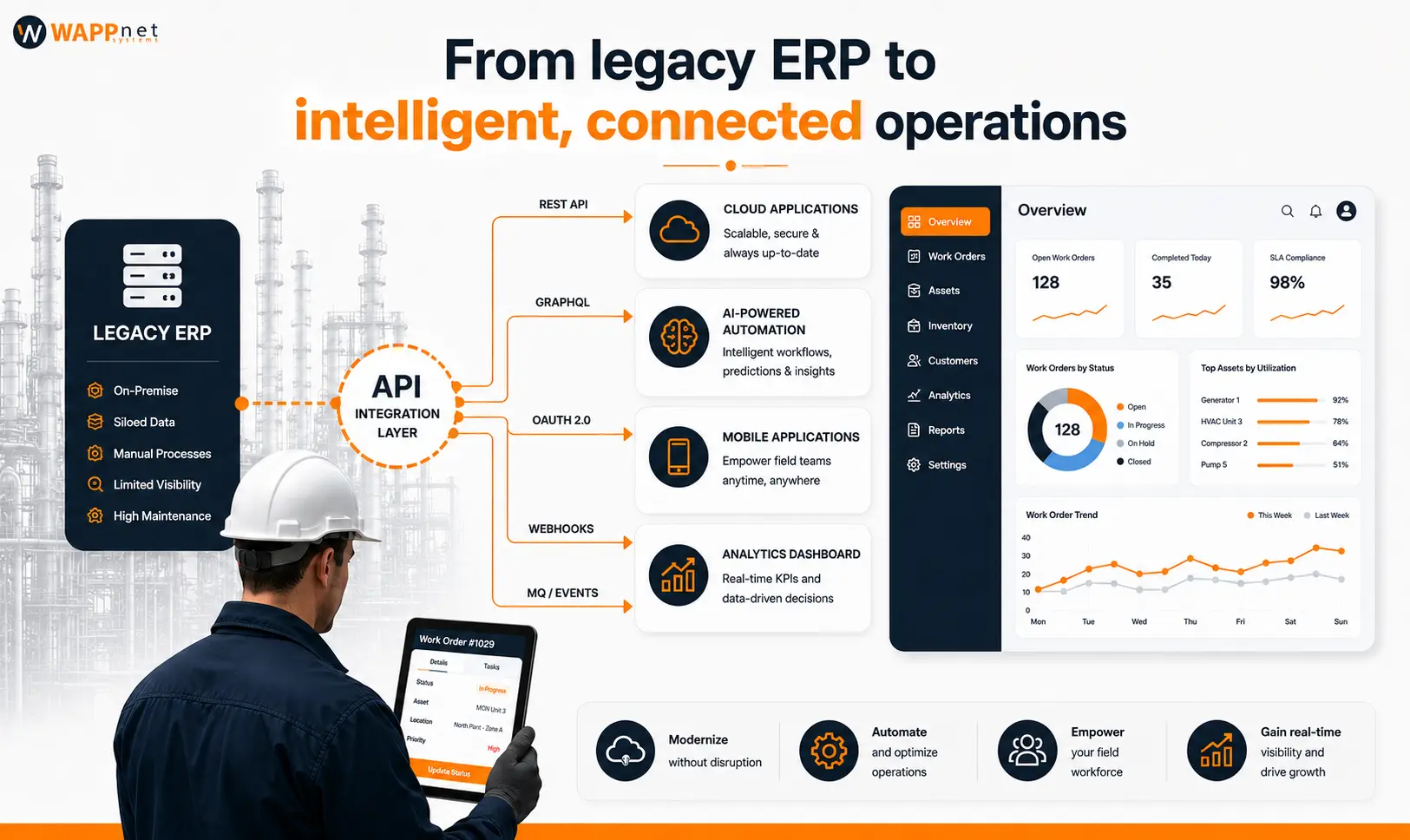
This is the question that stalls most digital transformation conversations, and understandably so; a full system replacement is expensive and risky if rushed. In most cases, a full rebuild isn’t necessary. Legacy application modernisation means connecting systems through APIs, migrating select components to the cloud, and layering in automation. It’s typically more cost-effective than an effort to replace legacy systems outright, and far less disruptive.
For most UK field service businesses, enterprise software modernisation is less about ripping out everything at once. It’s more about upgrading the weakest links first, via cloud migration alongside existing infrastructure.
Modernisation isn’t about replacing everything overnight it’s about removing the friction points that cost the most, in the order that gives the fastest return.
We work with field service, facilities management, and asset maintenance businesses across the UK to make modernisation manageable rather than overwhelming. That typically starts with a legacy assessment, understanding what’s working, what’s costing time, and where integration would deliver the fastest return.
From there, the work is practical rather than sweeping:
The goal is to reduce operational costs and improve technician productivity sustainably, with ongoing support as needs evolve.
Doing nothing has a cost it’s just harder to see on a spreadsheet than a software invoice. Every day a business runs on manual scheduling and paper-based processes, it’s paying the hidden cost of legacy systems in technician hours, delayed invoices, and missed opportunities.
Modernisation, by contrast, is an investment with a visible return: faster jobs, better first-time fix rates, and a system that scales with the business rather than holding it back. Legacy systems don’t usually fail all at once; they cost money quietly, every day, until modernisation becomes the cheaper option. If your team is still working around your software rather than with it, now is a reasonable time to have that conversation.
What is a legacy system?
A legacy system is older business software such as an on-premises CRM, desktop scheduling tool, or outdated ERP that still functions but wasn’t designed to integrate with modern tools, support mobile access, or scale with a growing field service operation.
Why are legacy systems expensive?
The expense goes beyond licensing. Legacy systems create hidden costs through manual data entry, missed appointments, slow reporting, delayed invoicing, and higher administrative overhead, all of which add up to significant lost productivity over time.
Should businesses replace or modernise legacy software?
In most cases, modernisation is more practical than a full replacement. Integrating existing systems through APIs, migrating to the cloud, and adding automation delivers many of the same benefits with less cost and disruption than rebuilding from scratch.
How does AI improve field service operations?
AI can improve scheduling accuracy, predict maintenance needs before equipment fails, optimise technician routes, and reduce repeat visits by improving first-time fix rates, all of which lower operational costs.
What are the signs a legacy system is outdated?
Common signs include slow performance, reliance on multiple spreadsheets, no mobile access for technicians, lack of API integrations, difficult or slow reporting, and rising support costs or downtime.
How long does legacy system modernisation take?
Timelines vary depending on scope, but a phased modernisation approach starting with an assessment and targeted integrations often shows measurable improvements within a few months, rather than requiring a lengthy, disruptive overhaul.