Call us USA (+1)312-698-3083
| Email : sales@wappnet.com
Customer Relationship Management (CRM) systems are now mandatory, not a luxury, in 2026; they are the engine of sales, marketing, and customer success. Zoho CRM and Salesforce CRM are two of the strongest competitors in this game.
But there is a significant change that is occurring in the SMB ecosystem. Small and medium-sized companies are also abandoning Salesforce and shifting to Zoho as their CRM system of choice.
Why is this happening?
The solution is easy: cost-effectiveness, reduced complexity, and quicker ROI.
Most SMBs now prefer to work with a Zoho CRM development firm or an established Zoho partner to get customized Zoho CRM solutions that are simple to operate and scale, as opposed to Salesforce.
Key Takeaways

Zoho CRM is a cloud-based customer relationship management system specific to startups, SMBs, and developing businesses. It belongs to the greater Zoho ecosystem comprising sales, marketing, finance, and automation solutions.
Key Capabilities:
Zoho has been popular among companies that seek Zoho CRM services at affordable rates, with swift deployment and less technical complexity.
Salesforce CRM is a business-level CRM system that is reputed to have a high level of customization and scalability.
Key Capabilities:
Although Salesforce is very powerful, it frequently demands specific technical teams and increased budgets to implement.
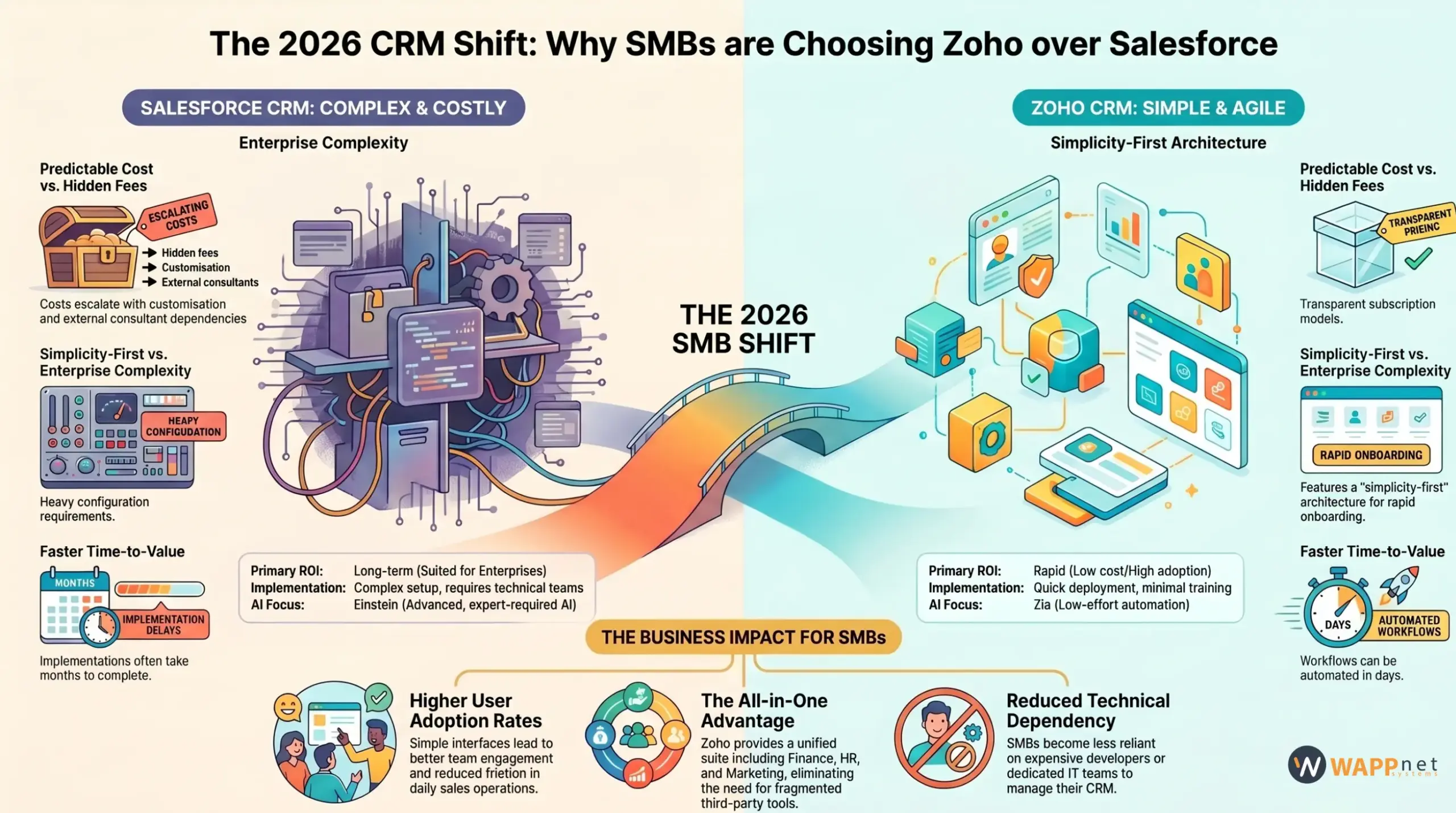
| Factor | Zoho CRM | Salesforce CRM |
| Cost | Affordable subscription model designed for SMBs | High licensing cost + extra charges for customization + consultant dependency |
| Ease of Use & Implementation | Simple setup, quick deployment, minimal training required | Complex setup, longer onboarding, often requires external consultants |
| Customization & Flexibility | Practical customization focused on SMB workflows and usability | Deep enterprise-level customization with advanced configuration capabilities |
| Automation & AI Capabilities | AI assistant Zia enables easy automation and predictive insights with low technical effort | AI-powered Einstein AI provides advanced enterprise-grade intelligence but requires expertise |
| ROI (Return on Investment) | Faster ROI due to low cost, quick implementation, and high adoption rate | Strong long-term ROI but typically suited for large enterprises with higher investment cycles |
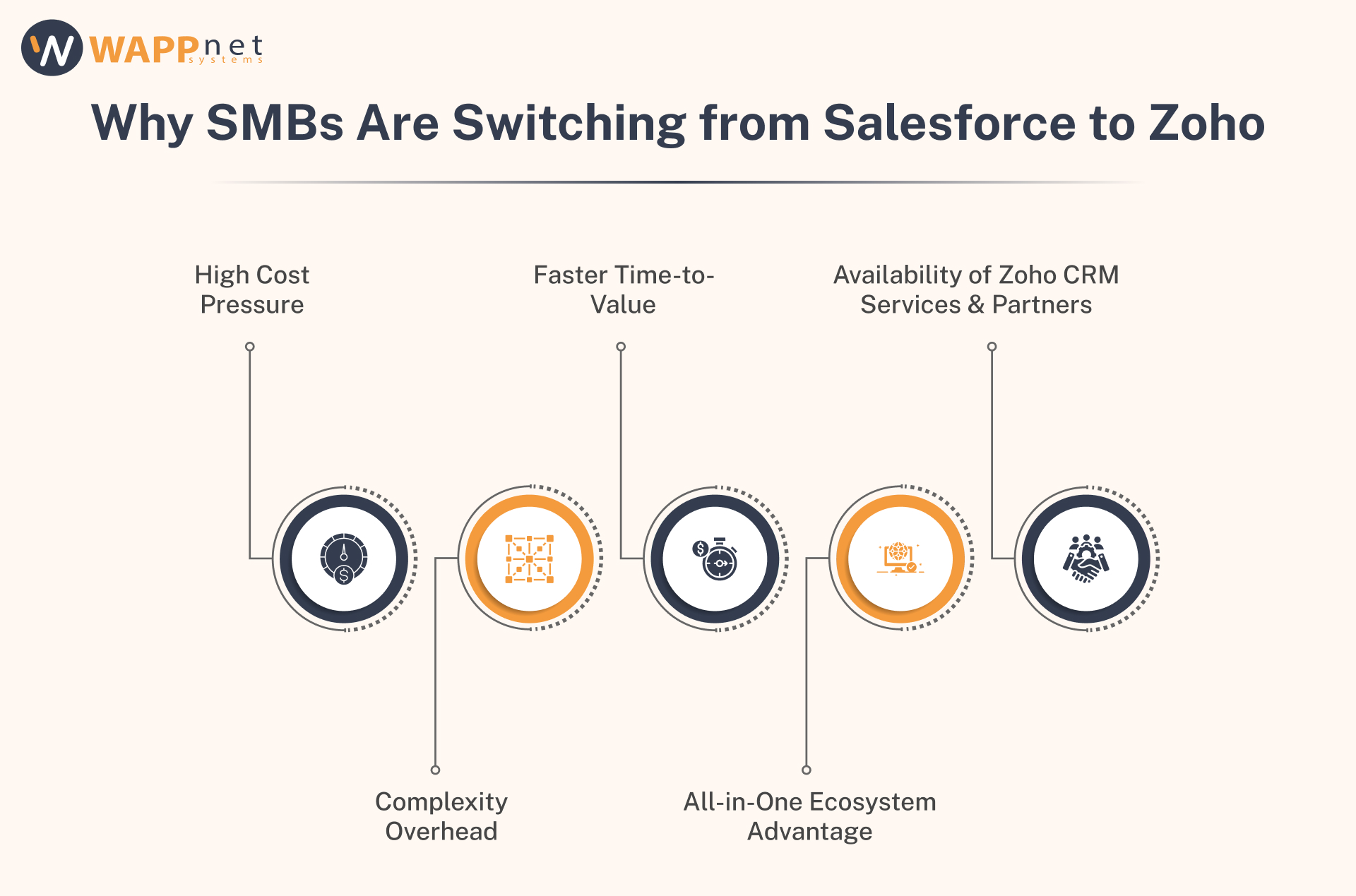
The Salesforce CRM-to-Zoho CRM transition is not a fad; it is a real response to changing SMB priorities, including cost-effectiveness, ease of operations, and shorter time-to-value.
The new generation of SMBs is no longer willing to spend a lot of money on sophisticated CRM systems that require extensive implementation periods and dedicated technical units. Rather, they are proactively embracing flexible platforms that are backed by a trusted Zoho CRM development firm or reputable Zoho partner to hasten the digital transformation.
1. High Cost Pressure
Cost scalability is one of the main causes of migration.
Salesforce is based on a premium pricing model where its costs are very high, such as
In the case of SMBs, this imposes a financial strain over the long term and unpredictable CRM expenditure.
Conversely, Zoho CRM provides a simple and less expensive subscription service, which allows companies to:
This is one of the most powerful forces that stimulates the use of Zoho CRM services among SMBs.
2. Complexity Overhead
Salesforce is intended to work in an enterprise-grade setting, which frequently leads to the complexity of the system.
SMBs frequently face challenges such as the following:
This complication slows down the adoption and decreases productivity in smaller groups.
Conversely, Zoho CRM is built on a simplicity-first architecture, which enables
This is the reason why a large number of companies are opting to engage the services of a Zoho CRM development firm to facilitate implementation without the distraction of operations.
3. Faster Time-to-Value
Time-to-value has emerged as a key KPI of new SMBs.
The implementation of Salesforce may require weeks or even months because of
This velocity benefit directly enhances business responsiveness and renders Zoho very appealing among startups and SMBs with blistering development.
4. All-in-One Ecosystem Advantage
Advantage: The other significant cause of migration is the integrated ecosystem method of Zoho.
In comparison to Salesforce, which tends to use various third-party applications, Zoho offers an integrated panel of business applications that include the following:
This integration will remove the need to use fragmented tools and will simplify operations. In the case of SMBs, this implies the following:
5. Availability of Zoho CRM Services & Partners
Another adoption driver is the expanding ecosystem of Zoho CRM services.
SMBs can simply work with a Zoho partner or Zoho CRM development firm, such as Wappnet, to gain access to the following:
Zoho is not a tool but a complete, supported business transformation platform due to its robust service ecosystem.
Read More: MLOps End-to-End Pipeline Tutorial: From Experiment to Production
When Salesforce Still Makes Sense.
Although the shift has occurred, Salesforce is still a good option under certain conditions:
– Big companies that have international business.
– Organizations that have very complex and multi-layered workflows.
– Companies with a strong need to always be customized.
– Firms that have specific IT staff and CRM managers.
To such organizations, the complex and expensive Salesforce capabilities are worth it.
Zoho CRM is the solution that will be selected when companies are interested in efficiency and scaling.
Zoho is ideal for:
Its price-to-quality and usability combination, and its ability to integrate with the ecosystem, make it a viable long-term option.
When Salesforce is migrated to Zoho, SMBs usually see quantifiable gains in their operations:
1. Reduced CRM Operational Cost
Reduced costs of licensing and implementation will save a lot of money in overall CRM costs.
2. Faster Sales Pipeline Activation
Faster deployment of the system will help the sales teams convert leads faster.
3. Higher User Adoption Rates
An easy interface results in enhanced engagement and adoption by teams.
4. Easier Automation Setup
The process of workflow and automation is not heavy technically.
5. Lower Dependency on Technical Teams
Businesses are less dependent on costly developers or consultants.
The 2026 CRM environment is definitely moving towards simplicity, low costs, and quicker ROI.
Although Salesforce continues to be a strong enterprise platform, Zoho CRM is becoming the platform of choice among SMBs thanks to its user-friendliness, affordability, and open ecosystem.
In case you are intending on CRM implementation, migration, or automation, you can consider collaborating with a reliable Zoho CRM development firm such as Wappnet to unlock accelerated growth with customized Zoho CRM services that will meet your business requirements.
1. Is Zoho better than Salesforce for SMBs?
Yes, Zoho is more suitable for SMBs because it is cheaper, can be set up faster, and is simpler to use.
2. Why are companies switching from Salesforce to Zoho?
A reason why companies switch is that Salesforce is expensive, complicated, and requires more time to implement.
3. What is a Zoho CRM development company?
Implementation, customization, automation, and integration services of Zoho CRM are offered by a Zoho CRM development company.
4. What are Zoho CRM services?
Zoho CRM services cover setup, customization, workflow automation, integration, migration, and support.
5. Is Zoho a good CRM for startups?
Yes, Zoho is among the most suitable CRMs in startups because it is cheap and can be deployed within a short period of time.
6. Do I need a Zoho partner for implementation?
A collaboration with a Zoho partner can be used to achieve an appropriate setup, customization, and quicker ROI.