Call us USA (+1)312-698-3083
| Email : sales@wappnet.com

The mobile app environment is changing more rapidly than ever, and legacy subscription strategies are not going to make it in a highly saturated market. Although subscription-based monetization has been a staple of recurring revenue, new value streams are now being unlocked by developers using hybrid strategies and decentralised technologies. By 2026, strategies such as interactive advertising, microtransactions, community-based models, and Web3 economies will gain mainstream adoption, reshaping how developers think about sustainable growth and user engagement. This blog explores how app monetization will evolve by 2026, focusing on subscription alternatives, Web3-based economies, and next-generation monetization frameworks that will redefine how apps generate value.
Key Takeaways
✔️ Diversification is essential: Subscriptions will be present in 2026, yet more and more about a mixture of monetisation streams.
✔️ Users demand choice: Micro-subscriptions and usage-based access are flexible pricing schemes that enhance conversion and reduce churn.
✔️ Engagement beats disruption: Interactive and rewarded monetisation formats help to improve the user experience and monetisation at the same time.
✔️ Community and creator economies unlock growth: The users are empowered to create, not to consume, and this creates loyalty and monetisation.
✔️ Web3 opens new frontiers: Tokenised and decentralised models are rich: NFT-based utility, token-based access have real potential to transform the value exchange in applications.

Here are some powerful data points reshaping the monetisation landscape:
The Web3 payment solutions market is projected to grow at a rate of +28% in 2020.
Subscription-based monetization has been highly effective, generating nearly 45% of total app revenue while being used by only about 4% of apps. However, this has created a widening gap between top-performing apps and the rest of the market.
Nowadays, users demand value, flexibility, and fairness. Consequently, creators are widening their monetisation approaches to comprise ad experiences, in-app purchases, token-based incentives, and even blockchain-based economies that provide empowerment to users and, at the same time, generate revenue.
Read More: How AI-Native Apps Will Redefine Business Automation by 2026
1. Hybrid Monetisation Leads the Market
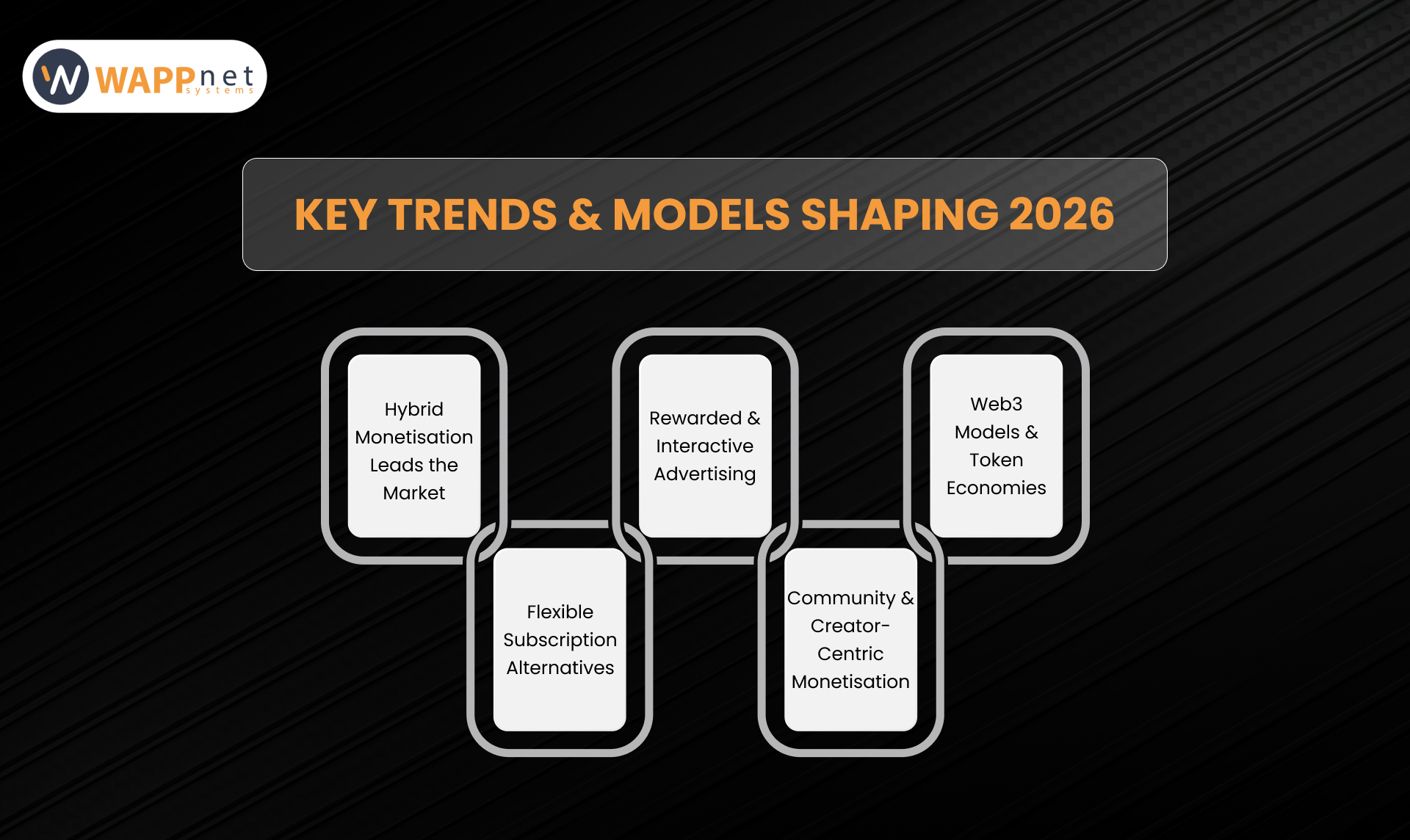
Gone is the time when a one-size-fits-all revenue strategy can be used. The most effective apps in 2026 will be those that bring together several streams of monetisation, like subscriptions, in-app purchases, rewarded and contextual advertisements, to achieve optimisation in terms of revenue per user and to avoid dependence on one stream.
Such a hybrid strategy improves lifetime value (LTV) and enables developers to personalize the experience of various groups of users, such as casual users and superfans.
Read More: Top AI Use Cases in 2025: Real-World Applications Transforming Industries
2. Flexible Subscription Alternatives
The subscriptions still play a significant role; however, the users are looking more at flexibility. Expect a rise in:
These alternatives make online products appear closer and equal, consequently increasing total sales.
3. Rewarded & Interactive Advertising
Advertisements have ceased to be passive. Rewarded and interactive advertisements engage users by offering in-app rewards or unlocking special features in exchange for interaction. The advantage of these formats is that they make the ad experience valuable and not intrusive to both the developers and the users.
4. Community & Creator-Centric Monetisation
Apps are becoming products where communities and creators can flourish. Monetisation is no longer limited to transactions to cover paid content, tipping, and fan subscriptions – a concept that can be compared to creator economies that compensate engagement and loyalty.
5. Web3 Models & Token Economies
One of the most transformative shifts in app monetization by 2026 is the integration of Web3 technologies. This ownership decentralisation and tokenised value capture allow developers to come up with genuinely new forms of monetisation.
Web3 subscription alternatives include:
The Web3-related payment solutions are already projected to rise quickly by market research, with the market of the wider Web3 payment systems projected to gain and expand exponentially (from approximately $12.3 billion in 2024 to an estimated multiple-hundred-billion-dollar market in 2037).
The mobile app ecosystem will look significantly different in how value is created and captured by 2026. The subscription models will still be relevant, but the ones that will be successful will be the ones that are creative in their approaches to blend, set prices, community interaction, and those that start to experiment with the Web3 subscription options and token economies.
By embracing app monetization trends for 2026, companies and creators can unlock new revenue streams, strengthen user loyalty, and remain competitive in an increasingly crowded digital marketplace.