How AI-Native Apps Will Redefine Business Automation by 2026
Introduction: The Automation Paradigm Shift
The simple task-based automation is dying. Over the years, companies have been using Robotic Process Automation (RPA) to replicate human behaviors such as clicking, data copying, and data transfer across systems, among others. However, as soon as change, messy data, or judgmental decisions are encountered, RPA will fail, which is why it has to be constantly interfered with by a person.
The true lever of efficiency will be AI-Native Applications- software that is designed and engineered inherently to be based on machine learning, large language models (LLM), and continuous learning. AI-native systems adjust, learn, and enhance themselves as opposed to traditional tools where AI is a makeup, which is not only an add-on.
This represents a significant change in the field of reactive, rule-based automation to proactive, smart, and autonomous decision making, which provides early adopters with a strong competitive edge.
Key Takeaways
Definition: AI-Native Applications are applications that are designed based on machine learning and can engage in constant learning and make decisions in real-time, as opposed to traditional rule-based RPA.
The Shift: AI-Native Apps Business Automation brings the enterprise beyond automating tasks and automating complexity and decision-making.
Agentic Power: This is due to the emergence of Autonomous AI Agents that will see processes orchestrated end-to-end without human oversight.
Industry Focus: Vertical AI is the second wave of Digital Transformation, where workflows in industry-specific AI-Native Applications are redefined by highly specific AI-Native Applications (e.g., finance, healthcare, legal).
Preparation: To achieve or become a future-oriented Business Automation success, it is necessary to invest today in the data quality, MLOps practice, and Explainable AI (XAI) in order to guarantee trust and compliance.
In 2026, 80% of businesses will involve AI-based automation systems, compared to 20 % in 2022 (Gartner).
Companies that use AI-native architectures have reported up to 35-50% efficiency in their operations, which is higher than the traditional RPA frameworks.
65% of automation failures in modern times are associated with the inability of rule-based systems to work with unstructured data, which supports the transition to AI-native solutions.
AIs working as autonomous agents will decrease costs of operation by up to 40% in finance, health, and logistics by 2026.
These forecasts clearly reveal that the AI-Native Apps will not merely transform the enterprise but will be the fundamental driver of change in enterprises.
Beyond RPA: Understanding the "Native" Advantage
The path to AI-Native Applications is a version of automation of tasks that goes beyond the simple to the cognitive automation. In order to value this change, it is important to comprehend the shortcomings of the past generation.
Conventional RPA systems are strong at performing inflexible tasks, but they are fragile in nature. They do not work when faced with the vagueness of the real world of business: a minor adjustment in a bill design, an e-mail with a chatty tone, or a difference in a customer request form. They are not well contextualized, and they view data as static information and not as an indicator of continuous improvement.
It is here that the native advantage lags with the concept commonly known as Intelligent Process Automation (IPA). Although a wider term, the AI-Native Applications model provides the most sophisticated version of IPA.
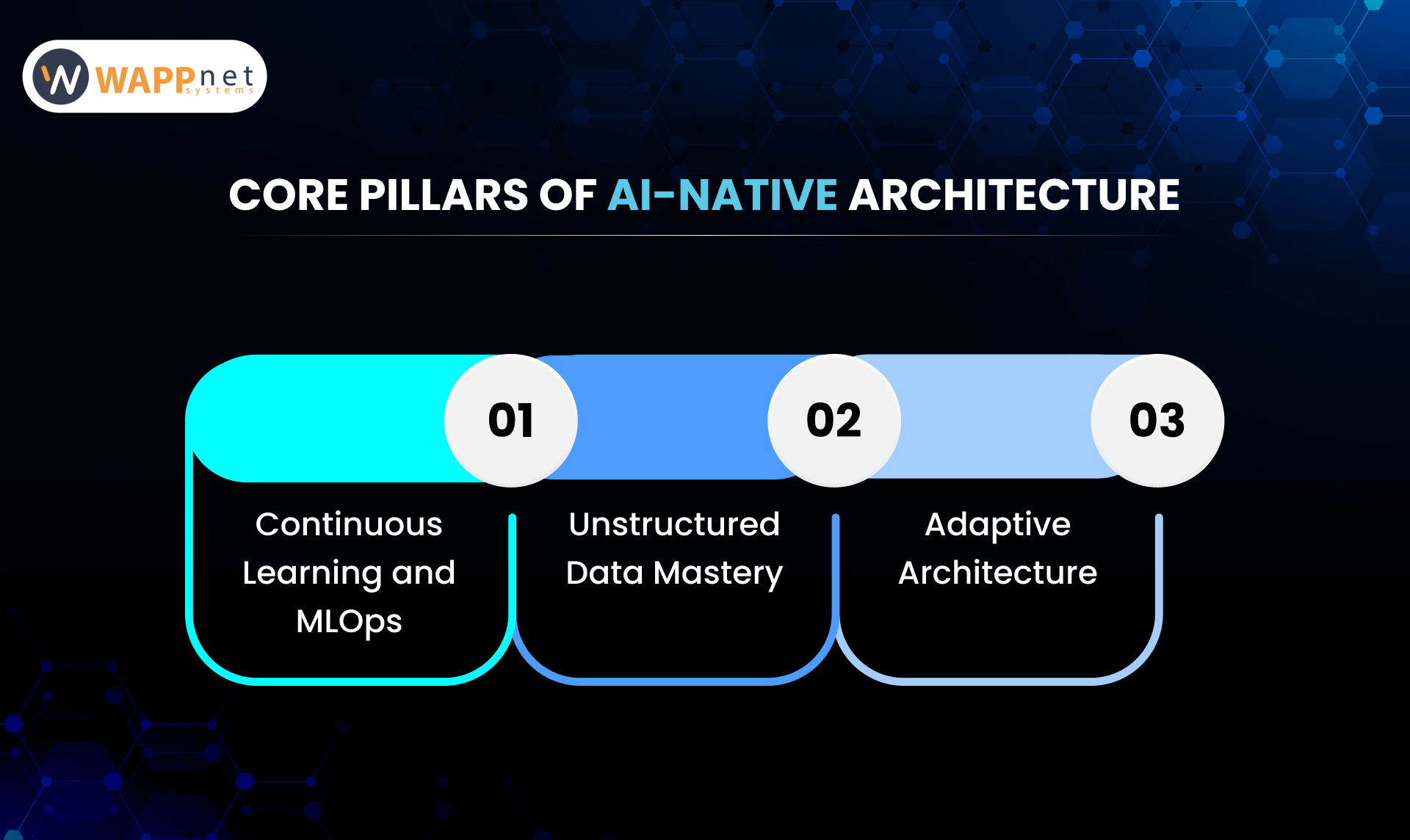
The core pillars of this architectural superiority are:
Continuous Learning and MLOps: The AI-Native systems are dynamic as opposed to static RPA scripts. They are designed in accordance with the principles of Machine Learning Operations (MLOps), which is why any process performed should be a new training loop.
When a system is able to deal with 95 % of the customer claims properly, the 5% of exceptions are examined, fed back into the model, and are used in refining the logic of the system on the spot. That is, it becomes smarter with each transaction, and it does not require expensive manual maintenance and retraining.
Unstructured Data Mastery: Most important business data, such as emails and contracts, transcripts, and reports, are unstructured. It is the AI-Native Applications that, based on the LLMs and deep learning models, do not consider these documents as blocks of text, but as sources of semantic information.
An AI-native claims app, e.g., does not search a field called Claim Amount but reads the policy text, reads the damage report, and generatively produces a recommended action, but is able to adapt variably with human-like understanding of the situation.
Adaptive Architecture: It is an architecture that is contextual. When one of the sales process automation tools realizes that a prospect has recently published a press release about a significant acquisition, the AI-Native Applications will automatically reprioritize that lead, change the tone of communication, and gather new contextual data, all in real-time. Rule-based systems cannot be responsive to such an extent.
With its direct integration into the core, AI-Native Apps Business Automation enables companies to automate complexity, rather than repetition.
The Rise of Autonomous AI Agents
The change in the architecture towards AI-Native Applications results in the realization of Autonomous AI Agents, the real implementers of the second wave of automation. They are not chatbots or just a set of scripts, but rather autonomous agents that are able to coordinate multi-step and multi-system processes in an enterprise with little human supervision.
The agency working workflow transformation alters the essence of the duties that are automatable:
From Task Completion to Goal Achievement: The conventional automation systems perform Task A, followed by Task B. Autonomous AI Agents are provided with a high-level Goal (e.g., Resolve this customer ticket with 90% satisfaction) and will constructively decide on the necessary steps, tools, and sequences to accomplish it.
Real-Time Tooling: These agents run in an open-ended system and can access any application or API within the limits of their capabilities. They are able to browse a CRM, query an ERP, create a custom response based on a generative model, and update a database, all of it smoothly in a single instance of a workflow.
Case Studies in Agentic Automation
Finance and Procurement: An Independent AI Agent in procurement does not simply process an invoice to a vendor; it performs an end-to-end audit. It is a scan of the invoice (unstructured PDF), cross-checking the PO number in the ERP, verifying the recent performance data of the vendor, and only in case all the checks are correct, the payment is sent to the final approvers.On discovering an anomaly, the agent automatically sends a query to the vendor and sets an exception flag on high priority to be reviewed by humans.
IT and Customer Support: Just imagine the Level 1 IT support process. Service desk tickets are received by an agent. The AI-Native Applications analyze the ticket (NLP) first, classify the issue, verify the role and recent activity of the user, then take a step further by initiating an action, an action that could be an auto-resolved common issue, a personal troubleshooting manual, or just in the case of a pattern, a bug report is filed automatically to the engineering team. This triage and resolution is done in seconds, and it significantly reduces the mean time to resolution (MTTR).
The Human-Agent Partnership: The introduction of Autonomous AI Agents does not mark the sign of replacement, but only intensification. Man becomes not a doer but a supervisor and planner.The employees will be concentrated on dealing with the 10 percent of high worth, complex exceptions, setting the targets of the agents, and focusing on strategy and innovation, and the agents will deal with the 90 percent of the repeatable and context-sensitive operational activities. Such an artificial partnership is the mark of the successful Future of Business Automation
Industry-Specific Redefinition: The Vertical AI Era
The effects of AI-Native Apps Business Automation will not be horizontal processes, such as IT and HR. Its strength is that it can be hyper-specialized, resulting in the so-called Vertical AI solutions, solutions that are developed entirely to address a unique and intricate problem of a particular industry, driving the next step of Digital Transformation.
Finance and Insurance: Dynamic Underwriting
Underwriting has long been a traditional insurance practice that is time-consuming and involves paperwork. The AI-Native Applications are transforming this by altering the situation of statistical risk assessment with dynamic, real-time risk modeling.
An AI-native underwriting agent will be able to consume claims information, market risk reports, and even regulatory changes (unstructured data) in real-time.
It then produces a risk score, automatically recalculates policy premium recommendations, and produces the necessary compliance documentation that a human underwriter needs to sign off.
This shift radically shortens the decision cycle, giving it an opportunity to use personalized, profitable underwriting at machine speed.
Healthcare: Administrative Intelligence
The healthcare system is plagued by huge administrative overheads. This is being addressed by AI-Native Applications by using the intelligent processing of documents and optimization of operations.
Medical records and clinical notes can be processed by the agents, diagnoses instantly classified, billing codes identified, and compliance issues that might arise flagged before the file is even reviewed by a human coder.
Moreover, AI Agents, which are autonomous, can handle multifaceted scheduling of surgical units or staffing by predictively modelling available resources so that they are optimized depending on the flow of patients and staff availability.
Legal and Compliance: The Cognitive Law Firm
Compliance and legal research entail the interpretation of large volumes of text that are constantly being updated. It is an ideal application of AI-Native Applications.
Legal services developed on vertical AI platforms include regulatory rules and case law embedded in them. A given business contract can be analyzed by an agent and immediately compared with the current jurisdictional laws, and any non-compliant clause identified and a remedial suggestion offered.
Not only does this accelerate the process of contract review, which was previously taking days to a few minutes, but it will also significantly diminish regulatory risk, allowing the enterprise to be agile and compliant in real time. Such a level of domain expertise cannot be achieved using generic and horizontal automation tools.
Preparing Your Business for the Future of Business Automation
The shift to AI-native apps business automation is an architectural and cultural endeavor, not a software upgrade. Companies that aspire to be successful by 2026 must take some proactive steps today in order to prepare the groundwork for this new, autonomous business.
1. Prioritize Data Quality and Centralization
The data is the fuel of all AI-Native Applications. The quality and accessibility of data consumed by Autonomous AI Agents are directly related to the performance of the Agents.
Actionable Step: In place, a data governance framework that is aimed at silo busting internally. You require a centralized, clean, and effectively structured source of truth that is capable of supplying ML models effectively. Lack of good data quality will result in poor model decisions, which makes automation counterproductive.
2. Embrace MLOps and Continuous Improvement
Lose fixed software release versions. AI-Native Applications are dynamic, and they need their own MLOps (Machine Learning Operations) pipeline.
Actionable Step: Investments in the infrastructure and talent required to deploy, monitor, and retrain the models continuously. The feedback loop should be short: The results of the real world should feed back into the model to be refined immediately. That is how your automation system gets to know how to deal with the exceptions it was unable to solve yesterday.
3. Build Trust with Explainable AI (XAI)
Trust is the most important, as Autonomous AI Agents make critical decisions in finance, HR, and compliance. The stakeholders need to be in a position to audit and comprehend the reason behind a decision.
Actionable Step: Require and roll out automation instruments with inherent Explainable AI (XAI) applications. Such tools should be able to give straightforward, auditable logs on the data points, model weights, and decision logic that is used to conclude. This control is indispensable, especially in the regulated sectors, and it is an unavoidable element of the Future of Business Automation.
4. Reskill and Reallocate Human Talent
The biggest issue is the cultural one. It is necessary to change the attitude of considering AI as a job replacement tool to a great partner.
Actionable Step: Introduce special upskilling initiatives. Train the employees so that they can stop doing repetitive jobs and supervise the work done by the agents, create sophisticated work processes, and work on the entire strategies and customer relations on a high level. The human position transforms towards efficiency to creativity, strategy, and empathy- activities that can not be done by machines.
The run-up to the years 2026 is the irreversible point of inflection of business automation. Gone are the days of software enabling AI with AI, as AI-Native Applications and Autonomous AI Agents are now supreme. These new systems will automate the complexity, change with, and finally operate whole processes with greater efficiency and smartness than ever before.
The organizations who acknowledge that AI-Native Apps Business Automation is not an app but a base, a complete reassessment of their fundamental operating paradigm, will be the ones that gain a competitive advantage in the market that is decisive and long-term. It is high time to begin developing this new independent business.
Frequently Asked Questions
What are AI-Native Applications?
AI-Native Applications are applications that are designed to be based on machine learning, large language models, and real-time inference and are not an extension. They learn continuously from data, automate complex decisions, and dynamically adapt without the maintenance of scripts that are manually written.
How do AI-Native Applications differ from RPA?
The traditional RPA is used to automate routine, rule-based processes, but fails when the data or formats are altered. AI-Native Apps work with unstructured information, comprehend meaning, and learn over time via MLOps and continuous learning loops.
What role will Autonomous AI Agents play in business automation?
Unlike AIs, Autonomous AI Agents are end-to-end workflows, and perform all tasks on their own, using enterprise tools and systems, and not merely taking steps. They enhance performance, speed, and accuracy in decision-making across operations to a great extent.
Which industries will benefit most from AI-Native Business Automation?
The finance, insurance, healthcare, logistics, and legal industries will undergo significant change since they are reliant on high volumes of unstructured data and intricate decision processes.
How should businesses prepare for the shift to AI-Native automation?
The companies need to invest in data governance, MLOps infrastructure, Explainable AI systems, and employee upskilling to work with autonomous agents effectively.
Ankit Patel is the visionary CEO at Wappnet, passionately steering the company towards new frontiers in artificial intelligence and technology innovation. With a dynamic background in transformative leadership and strategic foresight, Ankit champions the integration of AI-driven solutions that revolutionize business processes and catalyze growth.