Call us USA (+1)312-698-3083
| Email : sales@wappnet.com

Enterprise revenue teams are operating on outdated infrastructure. The battle for CRM hygiene is never-ending. Manual and error-prone lead routing. Pipeline leaks at sales and marketing handoffs. Forecasts are 20–40% off target due to broken, outdated data isolated across six platforms that have not been fully connected.
It’s not about effort; it’s about architecture.
Traditional RevOps systems were built for predictable, linear buyer journeys. That’s not what enterprises need to deal with in 2026. Multi-channel buyers, dozens of intent-signal platforms, and the complexity of scaling GTM motions without AI are simply too much.
The mission of AI GTM Engineering Services is to solve this at the infrastructure level not by introducing a new tool, but by re-engineering your entire GTM system using AI-driven logic, autonomous workflows, and real-time intelligence layers.
Key Takeaways

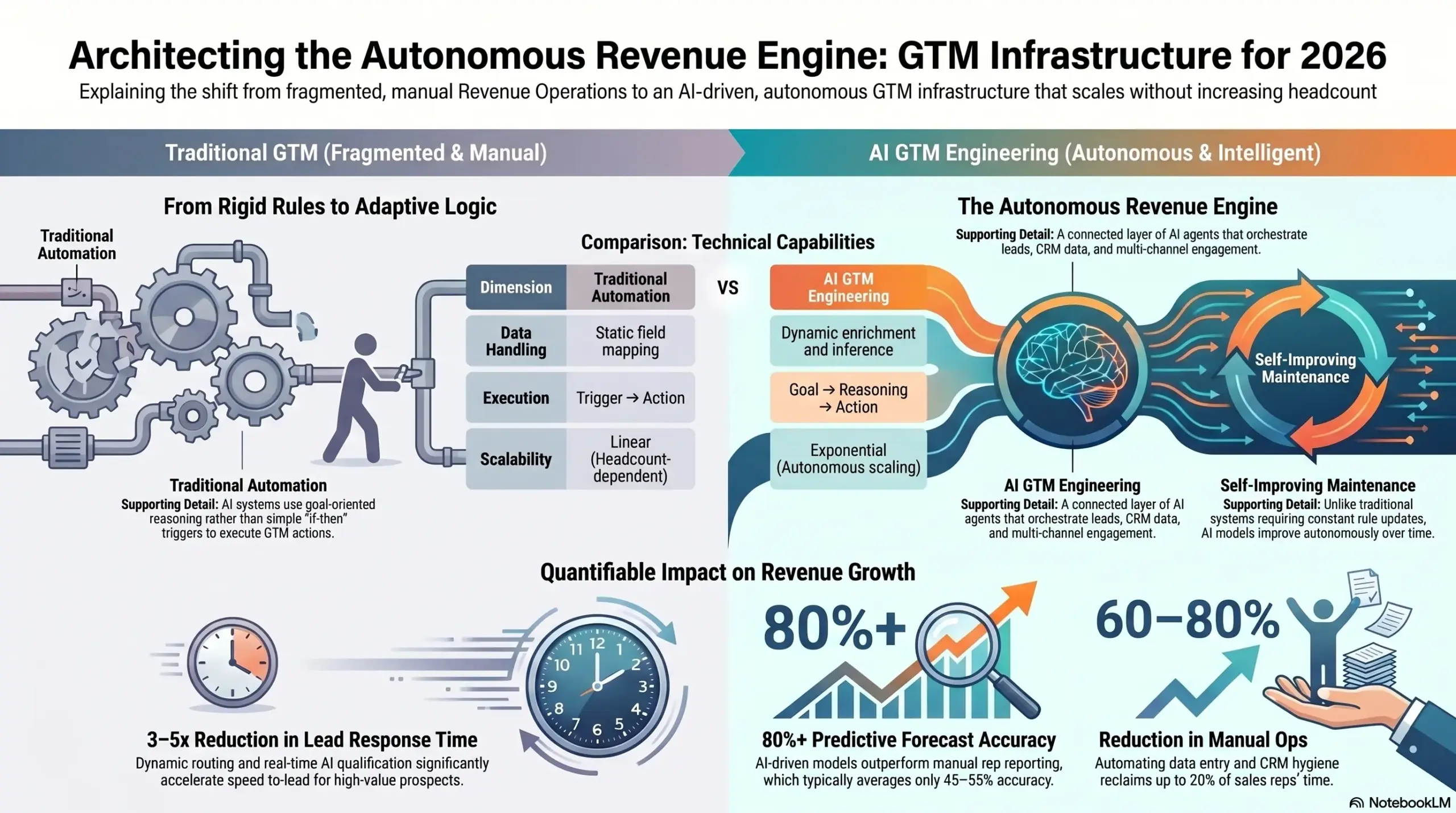
AI GTM Engineering Services offer end-to-end professional services to create, build, and manage go-to-market infrastructure powered by AI for enterprise revenue teams. They exist at the nexus of Revenue Operations (RevOps), systems engineering, and applied AI, transforming disparate GTM stacks into autonomous, connected revenue engines.
Core Components
| Dimension | Traditional Automation | AI GTM Engineering |
| Logic Type | Rule-based, rigid | Adaptive, context-aware |
| Data Handling | Static field mapping | Dynamic enrichment + inference |
| Execution | Trigger → Action | Goal → Reasoning → Action |
| Scalability | Linear | Exponential |
| Maintenance | High (constant rule updates) | Low (self-improving models) |
| Business Impact | Efficiency gains | Revenue transformation |
Traditional automation executes what you tell it to. AI GTM Engineering determines what actions to take based on signals, context, and outcomes.
The Scale of the Problem
Multi-Platform Data Silos—The data for engagements is stored in HubSpot. Data relating to the deals is stored in Salesforce. Product usage exists in Mixpanel. No single system is complete, and decisions are made based on partial information.
Pipeline Leakage at Handoff Points—Deals die at handoff points (SDR-to-AE, marketing-to-sales, and CS-to-expansion motions). At these interfaces, manual work introduces a delay, a lack of communication, and context.
Reporting Inefficiency — RevOps teams spend 30–50% of their time creating reports instead of analyzing them. Always, dashboards look backward.
Inability to Scale GTM Without Headcount — The traditional approach to outbound and inbound and CS requires proportional headcount growth. AI GTM systems solve this linear scaling constraint.
Demand for Predictive Intelligence—Not enough business boards and CROs can keep taking it in the back of the head. They require pipeline visibility, which means AI is needed at the data layer.

1. AI-Powered Lead Routing & Qualification
Challenge: Inbound leads are passed according to the static rules of territories and firmographic data without taking into account the intent signals in real time. High-value leads remain in queues for hours.
AI Solution: AI qualification models determine the score of a lead based on behavior (page visits, content downloads, email engagement), fit (firmographic attributes), technographic data, and CRM history. Routing logic is dynamic and based on urgency, ICP match, and rep availability simultaneously.
Outcome: The outcome is a 3–5x reduction in lead response time. This is due to a substantial rise in SQLs coming from the same inbound volume. Learn more about our AI GTM Engineering Solutions for frameworks of implementation.
2. Intelligent CRM Automation
Challenge: The challenge with CRMs is that when they are “live,” the data quality is poor. Sales reps do not update fields, duplicate records accumulate, and enrichment occurs weekly—if at all.
AI Solution: AI orchestration of your CRM, with AI agents watching activity signals (email opens, call logs, and LinkedIn engagement), auto-populating fields, fast merging duplicate records, and, in real time, enriching records on the fly through APIs (Clearbit, Clay, and Apollo).
Outcome: 90%+ CRM data accuracy. Reps no longer spend time entering data; they focus on selling instead. Forecasting models receive good inputs.
3. AI Sales Workflow Automation
Challenge: Sales sequences are standardized, timing is predetermined, and follow-ups do not adapt to buyer behavior. Personalization is manual and is not scalable.
AI Solution: Applying LLMs to sequence logic to tailor outreach according to account context, news, product usage signals, and deal stage. Sequences are dynamic, pausing when a prospect books a meeting and escalating when intent goes up.
Outcome: Increased open and reply rates. Shorter sales cycles. Reps specialize in high-context conversations, and AI takes care of volume.
4. Predictive Revenue Forecasting
Challenge: Forecasting depends on rep self-reporting, which is optimistic and has a recency bias. Pipeline reviews are subjective.
AI Solution: Historical win/loss data, deal velocity, engagement data, and economic signals are used to create predictive models. AI/ML development assigns probability scores at the opportunity level and identifies at-risk deals before they stall or disappear.
Outcome: Improved accuracy of forecasting: > 80% in mature implementations. CROs are not given after-the-fact performance evaluations.
5. Automated Pipeline Management
Challenge: No one knows when deals have stalled, and they miss the opportunity to act in time. Pipeline reviews happen weekly, while deal stagnation occurs daily.
AI Solution: AI agents continuously monitor your pipeline and alert you when engagement drops, next steps are overdue, or deal age shows anomalies. A system that automatically warns reps and managers when intervention levels are met.
Outcome: Increase in pipeline conversions. Reduced slippage. Pipeline health visibility at all scales, in real-time.
6. AI-Driven Customer Journey Orchestration
Challenge: The customer journey is fragmented across marketing, sales, and customer success. There is no single customer owner, and each team has an interpretation of the customer.
AI Solution: A single orchestration layer that connects stages of the customer journey within all systems. When a user demonstrates a specific behavior (such as opening an email, initiating an SDR call, logging into an app, or checking in on CS), AI initiates the appropriate action (email, SDR call, app login, or CS check-in) rather than a random trigger.
Outcome: Improved NPS, faster onboarding, and proactive churn prevention. Customer journey automation brings the customer journey full circle: from acquisition to retention.
7. GTM Data Synchronization & Enrichment
Challenge: Stalled, partial, or manual data exports between tools. CRM records are not real-time.
AI Solution: Real-time data orchestration pipelines that synchronize data bi-directionally between CRM, MAP, product analytics, support systems, and data warehouses. AI enrichment agents constantly validate and enrich account and contact records.
Outcome: A single source of truth that is always up-to-date. Improved segmentation, targeting, and personalization downstream.
Data infrastructure design is an integral part of our revenue operations automation services.
8. AI Copilots for Sales Teams
Challenge: Reps are often underprepared for calls. Follow-up after a call is not consistent. Competitive objections are not addressed using institutional knowledge.
AI Solution: Copilots that integrate into the sales process , such as pre-call briefings, real-time battle cards during conversations (via apps like Gong or Chorus), and automated follow-up emails with CRM integration.
Outcome: Rep consistency, no matter the level of experience. Faster onboarding for new employees. The knowledge that is built up in an institution cannot be limited to individual reps.
9. Multi-Channel GTM Automation
Challenge: Outbound teams operate in silos, with email, LinkedIn, paid, and content teams working separately, resulting in inconsistent customer experiences and lost opportunity for attribution.
AI Solution: A coordinated multi-channel orchestration layer enabling AI to sequence emails, LinkedIn, paid retargeting, and direct mail campaigns based on the engagement of the account. Attribution models bring together signals in channels.
Outcome: Scaled, coherent account-based experiences. Better attribution. Increased conversions with synchronized touchpoints.
10. Revenue Intelligence & Analytics
Challenge: There is extensive revenue data, but limited actionable insight. Dashboards do not predict or explain outcomes; they only report what has already occurred.
AI Solution: Revenue intelligence platforms that leverage LLM technology to ingest data throughout the GTM stack, uncover anomalies, uncover winning patterns, and make recommendations at a deal, segment, and portfolio level.
Outcome: Greater strategic clarity for GTM leadership. Pattern recognition-based decisions, not gut feel.
The following are the layers of a mature enterprise GTM infrastructure:
CRM & Data Core
AI Workflow & Orchestration
Intelligence & Enrichment
Outbound & Engagement
Analytics & Reporting
The stack itself is not the strategy. The engineering that connects, orchestrates, and optimizes across these layers is where the real value is created. Organizations looking to build this infrastructure end-to-end benefit from partnering with an experienced enterprise AI solutions provider rather than piecing together point solutions.
| Benefit | What It Looks Like in Practice |
| Faster Revenue Growth | Shorter sales cycles, higher conversion, faster lead-to-close velocity |
| Forecast Accuracy | 80%+ prediction accuracy vs. 45–55% baseline |
| Reduced Manual Ops | 60–80% reduction in manual data tasks for RevOps teams |
| Sales Productivity | Reps reclaim 15–20% of their time for selling activities |
| Lead Conversion | AI-qualified leads convert at 2–4x the rate of manually routed leads |
| GTM Scalability | Scale outbound and pipeline operations without proportional headcount |
| Decision Quality | Real-time intelligence replaces opinion-based pipeline reviews |

1. Data Quality Issues
The quality of AI models is directly proportional to the quality of the data powering them. However, enterprises with poor-quality CRM data require a data remediation step first to ensure that AI can provide accurate results.
Solution: Embed a data quality baseline assessment in the pre-implementation process. Clean up first before you automate using an AI tool for deduplication and AI-assisted enrichment.
2. Tool Fragmentation
The majority of enterprises will have 12-18 GTM tools and some partial, inconsistent integrations. AI has no control over what it cannot access.
Solution: The answer is to add an integration layer (iPaaS or custom API layer), then add AI orchestration. Our custom software development capabilities are purpose-built for exactly this kind of system consolidation challenge.
3. Change Management
Sales teams dislike AI tools that feel like surveillance or when they feel like they are being replaced. When sales teams feel like they are being “kept under surveillance” or when the AI undermines their independence, they are not going to like it. When AI is not used as a rep enablement tool, it fails in the adoption process.
Solution: Lead with value first (Value Copilots, Value Prep Briefs, Auto-logging). Let individual reps know how much they improved their personal efficiency in their first 30 days.
4. AI Governance & Accuracy
Bad data or insufficient guardrails can cause autonomous AI agents to harm customer relationships or bring compliance exposure.
Solution: Implement human-in-the-loop checkpoints for significant actions (such as contract changes and outreach escalations). Establish boundaries of AI use in policy prior to deployment.
5. Workflow Complexity
Enterprise GTM workflows are often regionally variable, exception-driven, and undocumented. To automate them effectively, they must first be mapped.
Solution: Document the workflow and use solution design as a first phase of every GTM engineering engagement.
6. Security & Compliance
Customer data must be processed by GDPR-compliant AI systems, plus industry-specific regulations, such as SOC2. LLMs can, unintentionally, reveal PII.
Solution: Data Masking, Access Control, and Audit Logging at the AI Layer. Test with the legal/compliance department before going live.
Fully Autonomous RevOps Systems (2025–2027)
AI agents will not only support revenue workflows; they will increasingly own them. A larger percentage of the pipeline will move through without any human touch in the process of inbound qualification, outreach sequencing, meeting prep, and post-call follow-up.
AI-Native CRM Ecosystems
The next generation of CRM platforms will come with AI reasoning natively, rather than being added on. In simpler stacks, the need for AI orchestration layers will be eliminated by the new generation of AI-native CRMs such as Salesforce Einstein, HubSpot Breeze, or the new generation of AI-native CRMs.
Read More: 15 Powerful Zoho Automations That Save Businesses Hundreds of Hours Every Month
Predictive Pipeline Intelligence
Deal-level AI prediction will take a step from “flags” to narrative, where AI systems will not only predict that a deal is at risk but also give specific recommendations on what to do about it.
Conversational Analytics
RevOps leaders will be able to ask for their pipeline and revenue information in natural language. What deals closed fast in Q1, and what did they share in common? will return structured analysis in seconds.
Real-Time GTM Optimization
Real-time actionable recommendations for campaign performance, messaging effectiveness, ICP targeting, and more will be optimized in real-time—closing the loop between action and learning in hours, not quarters.
Human + AI Collaboration
The winning GTM teams of 2026 and beyond will be those that set clear boundaries for the role of human-AI collaboration: where AI takes care of volume, consistency, and pattern recognition, while humans take care of the relationship, judgment, and strategy.
This is the hybrid architecture that our RevOps Engineering Services are based on: AI does most of the work; your team does the high-value work.
Revenue Operations isn’t in need of yet another dashboard. It requires an update to its operating system.
AI GTM Engineering Services offer just that: a rethinking of enterprise go-to-market systems, from the ground up. It is not about the size of the GTM team or the number of tools; it is about the organizations that win in 2026. They’re the ones that created AI-driven infrastructure to route, qualify, predict, and orchestrate, requiring little to no human involvement, letting their best humans do the things only humans can do.
This transformation is not a future possibility. It is happening right now, and the chasm between the companies that have modernized their GTM infrastructure and those that are still dealing with spreadsheets and manual handoffs is growing every quarter.
If your revenue operations still rely on manual logic, disorganized tools, and outdated reports—it’s time to design your GTM for the AI age.
What are AI GTM Engineering Services?
AI GTM engineering services are specialized consulting and implementation services to design and deploy AI-powered go-to-market infrastructure. These services combine revenue operations strategy, systems integration, AI workflow automation, and data engineering to enable autonomous, intelligent GTM systems that boost pipeline velocity, forecast accuracy, and sales productivity at scale.
How does AI improve revenue operations?
By automating manual workflows, enriching and synchronizing data in real time, delivering predictive health of the pipeline, routing leads through dynamic scoring models, and managing leads across multiple channels, AI enhances the revenue operations. The outcome is quicker revenue cycles, improved conversions, and improved forecasting without a proportional increase in team size.
What is the difference between RevOps and GTM Engineering?
RevOps (Revenue Operations) is the strategic integration of Sales, Marketing, and Customer Success, all based on common data, processes, and KPIs. The technical discipline of building and maintaining systems, integrations, and automated workflows that make RevOps work at scale—the discipline that’s GTM Engineering. RevOps is the strategy, and GTM Engineering is the infrastructure that implements it.
Which enterprises benefit most from AI GTM systems?
AI GTM systems are most beneficial for B2B companies that have sales cycles of 30 days or longer, GTM teams of 50+ people, multiple products/markets, multi-stack, and high deal volume. The ideal candidates are SaaS companies in the process of growing from Series B to enterprise or traditional businesses undergoing the digital transformation of their sales process.
How does AI help sales automation?
AI expands sales automation beyond rule-based workflows into adaptive, context-driven systems. AI can digest buyer behavior, automatically personalize sequences, log activities into CRM, provide relevant battlecards during calls, summarize after calls, and flag deals at risk, without manual rep input.
What tools are used in AI GTM engineering?
The components of a mature AI GTM stack generally consist of CRM systems (Salesforce, HubSpot), data warehouses (Snowflake, BigQuery), AI orchestration tools (n8n, Make, custom LLM agents), revenue intelligence platforms (Gong, Clari), data enrichment platforms (Clay, Clearbit, Apollo), sales engagement platforms (Outreach, Salesloft), and ABM platforms (6sense, Demandbase). These systems are integrated into and orchestrated in the engineering layer.
Is AI GTM Engineering suitable for SaaS companies?
Yes—the SaaS companies are one of the most affected. AI GTM systems can easily automate product-led growth (PLG) motions, trial-to-paid conversions, expansion revenue triggers, and churn prevention. SaaS businesses can embed the use of the product data into their GTM processes and establish closed-loop systems for driving sales and CS action in real-time.
How can businesses implement AI-powered RevOps?
Implementation is typically completed in phases : (1) Data audit and CRM health remediation; (2) Integration layer build-out and system consolidation; (3) AI model training and workflow orchestration design; (4) Pilot deployment with defined GTM motion (e.g., inbound qualification); and (5) Measurement, iteration, and scaled rollout. This timeline is shortened to 8–16 weeks when engaging a GTM Engineering Services partner for the first deployment of production.