Call us USA (+1)312-698-3083
| Email : sales@wappnet.com

A deep dive for engineers and decision-makers: how per-service pipelines work, real-world workflow examples with code, and an honest comparison with alternatives.
This guide explores modern CI/CD for microservices, including per-service pipeline design, microservices deployment strategy, and real-world DevOps best practices used by high-scale engineering teams in 2026.
CI/CD is how you keep microservices from turning into micro-chaos: automated, consistent, and safe enough to ship many times a day.

When you have one application, you can get away with a lot. Merge to main, SSH into the server, pull the latest code, and restart. It is manual, it is fragile, and it is exactly what most teams do when they are small and moving fast.
The cracks start to show the moment you add a second service. Now there are two deploys to coordinate. Two servers to SSH into. Two sets of environment variables to manage. Two teams that both want to ship on a Tuesday afternoon.
Scale that to a dozen services, and the cracks become structural failures. Who is deploying what and when? If production breaks ten minutes after three different services went out, which one was responsible? How do you roll back just one service without touching the others? These are not hypothetical problems.
They are the day-to-day reality of every engineering organization that has outgrown a monolith without putting the right delivery infrastructure in place. In modern engineering organizations, this challenge is commonly addressed through CI/CD pipelines for microservices, where each service follows an independent deployment lifecycle aligned with microservices DevOps best practices.
This document covers the full picture: what per-service CI/CD actually means in practice, how it compares to simpler and more manual approaches, real pipeline configurations you can adapt, and case studies from companies that have solved this at scale.
It is written for both the engineer who will build and maintain these pipelines and the decision-maker who needs to understand the investment and the return.
The instinct when moving from a monolith to microservices is to take the existing build-and-deploy pipeline and point it at each new service. One pipeline, many services. This feels efficient because it is familiar. In practice, it creates a set of problems that compound as the service count grows.
The first problem is coupling. If service A and service B share a pipeline and service B has a flaky test, service A’s deployments are blocked. Teams lose the autonomy that microservices were supposed to deliver. Instead of shipping when a feature is ready, they are waiting in a queue behind another team’s build failure.
The second problem is unnecessary work. In a monorepo, a single pipeline that triggers on any commit will rebuild and retest every service whenever anyone touches anything. Changing a comment in service C should not trigger a full build of services A through Z. At a small scale, this is merely wasteful.
At a large scale, it makes the pipeline so slow that teams start working around it, which defeats the purpose entirely. This is where a dedicated per-service pipeline becomes essential, allowing each microservice to follow its own optimized CI/CD workflow without unnecessary rebuilds or deployment coupling.
The third problem is the blast radius of a bad deploy. When everything ships together, a bad change in any service can take down the whole system. Rolling back means reverting all services to their previous versions simultaneously, which is complex and error-prone. Per-service deployment, by contrast, contains the damage: a bad deploy to service B affects service B. Everything else keeps running.
Continuous integration means every change is built and tested before it is merged. For microservices, this has two specific requirements that a monolith pipeline does not need: it must trigger only on changes to the relevant service, and it must give feedback fast enough that engineers do not work around it.
A CI run that takes forty minutes will be bypassed. Engineers will merge to the main branch and move on, checking back after lunch to see if anything is flagged as red. By then, three other changes have been added on top of theirs; the failure is difficult to attribute, and the fix takes longer than if the test had run in five minutes. The practical target for a per-service CI run is under ten minutes for lint, unit tests, and a slim integration test. If it is slower than that, the pipeline design needs attention.
Continuous delivery means every change that passes CI could go to production without additional manual steps. In practice, most organizations still use environment stages (dev, staging, production) and may require a manual approval gate before the final promotion.
The key principle is not the absence of human judgment but the consistency of the mechanism: the same image that was tested in dev is the image that goes to production. Nothing is rebuilt. Nothing is configured differently at deploy time. This approach aligns closely with modern Docker image versioning, immutable infrastructure principles, and GitOps deployment models used in Kubernetes-based microservices environments.

The following describes the typical shape of a per-service CI/CD workflow in a production engineering organization. The specific tools vary (GitHub Actions versus GitLab CI versus CircleCI), but the structure is consistent.
The following is a minimal but production-ready GitHub Actions workflow for a Node.js microservice. Tests run on every push and pull request. The Docker image is built and pushed to the container registry only on merges to main.

For a monorepo, add path filters to ensure the workflow only runs when this service’s code changes:

GitLab CI: Single-Service Pipeline
The same pattern in GitLab CI. Three stages: test, build (image push), and deploy. The deploy stage uses kubectl to update the running deployment in the dev namespace. The only change directive in each job ensures this pipeline runs only when the relevant service’s files change.

Similar configurations are commonly used in enterprise environments adopting DevSecOps in microservices, where automated testing, container scanning, and policy enforcement are integrated directly into the pipeline.
Thousands of deploys per day—per-service pipelines at extreme scale
Netflix operates hundreds of microservices with engineering teams distributed globally. Their Spinnaker platform (now open-source) was built specifically to solve the per-service deployment problem at scale. Each service has its own pipeline, deployment policy, and rollback strategy.
Netflix engineers have written publicly about the cultural shift that came with this architecture: the concept of a “release day” disappeared entirely. Deploys became so routine and so safe that individual engineers would push to production multiple times in a single day without ceremony.
The key enablers were immutable artifacts (every deploy is a new AMI or container image), automated canary analysis (new versions receive a small fraction of traffic and are automatically promoted or rolled back based on metrics), and a culture that treated rollback as a sign of a healthy system rather than a failure.
Organizations operating at this scale rely on advanced microservices deployment strategies, progressive delivery techniques, and automated rollback mechanisms to sustain thousands of independent service releases per day.

Before investing in per-service CI/CD infrastructure, it is worth understanding what you are comparing against. The table below summarizes the trade-offs across three common approaches: no CI/CD (fully manual), a basic single shared pipeline, and a per-service automated pipeline.
| Criteria | No CI/CD (Manual) | Basic Single Pipeline | Per-Service CI/CD |
|---|---|---|---|
| Deploy frequency | Hours to days | Daily (with coordination) | Many times per day |
| Feedback speed | After deploy to prod | After merge to main | On every PR — minutes |
| Blast radius | Whole system | Whole system | One service |
| Rollback speed | Minutes to hours | Minutes | Seconds — previous image |
| Team autonomy | Low — central gating | Low — shared pipeline | High — teams own their pipe |
| Audit trail | None/ad hoc | Partial | Full — image, commit, time |
| Monorepo support | N/A | Poor (rebuilds everything) | Good with path filters |
For a solo developer or a very small team with a single service and a low deploy frequency, manual deployments are a reasonable starting point. The overhead of configuring a full CI/CD pipeline is not justified when you are deploying once a fortnight and have complete visibility into every change.
The cost of manual deployments is primarily paid in scale: it increases roughly linearly with the number of services and the number of deployments and becomes untenable once both are in double digits.
A single shared pipeline works for teams that have moved to microservices but have a small number of services (fewer than five or six) and a low deploy frequency.
The main limitation is the lack of per-service Isolation: a failing test or a blocked deploy in one service affects all others. If teams are not stepping on each other yet, this limitation is theoretical. As soon as they are, the per-service approach becomes clearly superior.
Per-service CI/CD is the right default once you have multiple teams, multiple services, and a desire to ship frequently. The investment in configuration and tooling pays back in team autonomy, deployment safety, and the ability to isolate and contain failures.
The per-service model also scales: adding a new service means adding a new pipeline configuration file, not restructuring a shared system.
Per-service CI/CD does not run itself. There is a genuine upfront investment in design, tooling, and process that needs to be made intentionally and maintained over time. Underestimating this investment is one of the most common reasons CI/CD initiatives stall.
Continuous deployment culture: from weekly releases to 50+ deploys per day
Etsy is one of the earliest public examples of a company adopting continuous deployment at scale. In 2011, they published widely read engineering posts describing their transition from weekly release cycles to deploying more than fifty times per day.
The key cultural and technical changes were per-engineer ownership of deploying their own changes to production (no separate “ops” gate), a deployment tool (Deployinator) that made pushes visible to the whole team in real time, comprehensive feature flags to decouple deploy from release, and a post-deployment monitoring dashboard that correlated deploys with site metrics within seconds.
The business outcome was not just faster shipping; it was a dramatic reduction in the anxiety associated with deployments. When deploys are frequent and safe, each deploy is low stakes. The risk that used to accumulate in a weekly batch release was distributed across dozens of small, contained changes.
Etsy’s transformation illustrates early adoption of platform engineering best practices, where deployment tooling became an internal product enabling autonomous teams to ship safely and frequently.
The right time to invest in per-service CI/CD infrastructure is before you feel the pain acutely, not after. The patterns that work at five services are usually already strained at ten and genuinely broken at twenty. Building the right foundation early is significantly cheaper than retrofitting it under operational pressure.
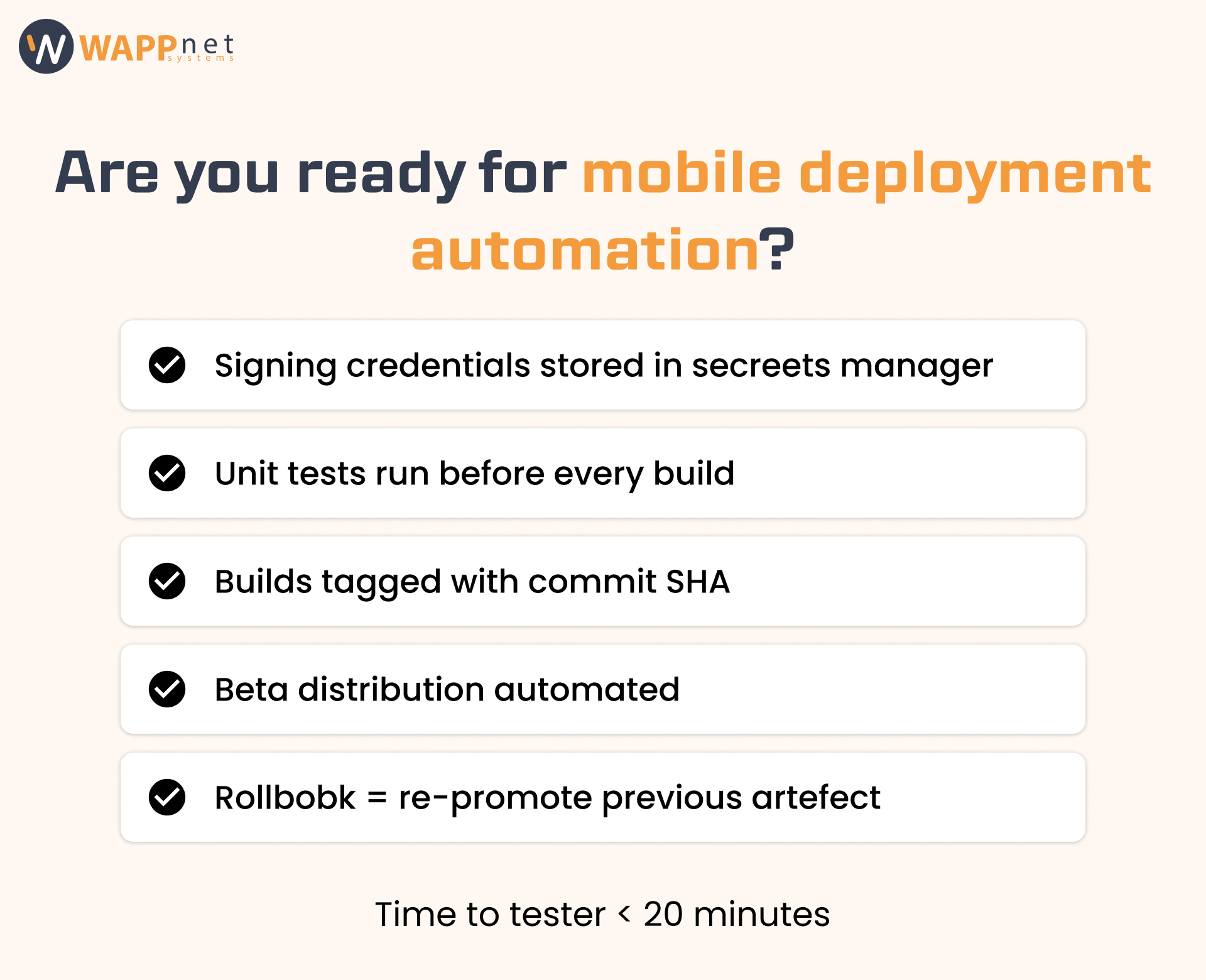
✓ Does each service have its own pipeline that runs independently of others?
✓ Is every deployed artifact an immutable, versioned image in a central registry?
✓ Can you roll back any service to its previous version in under two minutes?
✓ Do deployment events appear in your observability tooling with timestamps and version labels?
✓ Can a team deploy its service to production without coordinating with other teams?
As engineering organizations look toward CI/CD trends 2026, emphasis is shifting toward progressive delivery, GitOps automation, security-first pipelines, and platform-driven per-service CI/CD models.
Microservices CI/CD is not a Jenkins job or a Docker build. It is a set of principles and practices that, when implemented well, change the economics of software delivery: faster feedback, smaller blast radius, independent team autonomy, and rollback as a routine operation rather than an emergency measure.
The CI side of the equation ensures the main stays healthy by running the right tests on every change, quickly and without affecting other services. The CD side ensures that the artifact tested in development is the artifact running in production, deployed per service, and promotable or reversible at any time.
The investment is real: pipeline configuration, a registry, environment parity, observability, and platform ownership. The return is also real: the ability to run twenty or a hundred services without deployment becoming the primary source of risk and friction in the engineering organization.
Companies that have made this investment consistently report faster release cycles, fewer production incidents attributable to deployment, and engineering teams that spend significantly less time on deployment coordination and significantly more time on building product.
The question is not whether per-service CI/CD is the right model. For any organization with multiple services and multiple teams, it is. The question is how to phase the investment so that each step delivers value before the next one begins.
1. What is Microservices CI/CD?
Microservices CI/CD is a continuous integration and continuous deployment approach where each microservice has its own independent build, test, and deployment pipeline.
Unlike monolithic systems, changes to one service do not require rebuilding or redeploying the entire application. This allows teams to release updates faster, reduce risk, and scale engineering operations efficiently.
Modern microservices CI/CD pipelines typically integrate containerization (Docker), orchestration (Kubernetes), automated testing, and GitOps-based deployments.
2. How Is CI/CD Different for Monoliths vs Microservices?
In a monolithic architecture, CI/CD pipelines build and deploy the entire application as a single unit. Even small changes require a full system redeployment.
In contrast, microservices architectures use per-service CI/CD pipelines. Each service is:
This approach increases release frequency but also requires stronger deployment governance and monitoring strategies.
3. What Is a Per-Service Pipeline?
A per-service pipeline is a CI/CD workflow dedicated to a single microservice.
It typically includes:
This model enables isolated deployments, faster rollbacks, and parallel engineering workflows across teams.
4. How Do You Roll Back a Microservice Deployment?
Rolling back a microservice deployment depends on your deployment strategy, but common approaches include:
Advanced organizations use progressive delivery techniques combined with automated health checks to enable near-instant rollback in production environments.