Call us USA (+1)312-698-3083
| Email : sales@wappnet.com

Whenever the companies are considering developing cross-platform apps, one argument surfaces in nearly all conferences:
React Native or Flutter: Which is the smarter investment?
The two technologies enable businesses to create Android and iOS applications using the same codebase. They both minimize development time. They both can become millions of users.
However, their ecosystems, UI strategies, hiring patterns, and long-term flexibility differ in ways that may significantly affect the success of their products.
This guideline outlines the decision in more informative and business-oriented terms.
Key Takeaways

React Native usually feels at ease when the speed of hiring and rapid delivery of MVP are of paramount importance.
Flutter is desirable in case design control is mission-critical, as well as visual consistency.
However, the majority of real-life decisions demand a more intensive analysis.
It is maintained by Meta Platforms and allows developers to write mobile applications using JavaScript and ideas of React and render the real elements of the native platform.
Owing to its resemblance to web development, organizations seeking a React Native app development company tend to experience expedited team building and reduced time to onboard.
React Native is bright where companies want to repeat the process of iteration regularly, has a powerful community, and offers hiring in a large market.
Google has developed Flutter based on a powerful rendering engine. Flutter is not based on native UI elements but rather pulls the interface.
It implies that the teams can realize very consistent designs, deep animations, and brand accuracy. Companies analyzing the Flutter app development services are often design-led or creating high-quality digital interactions.
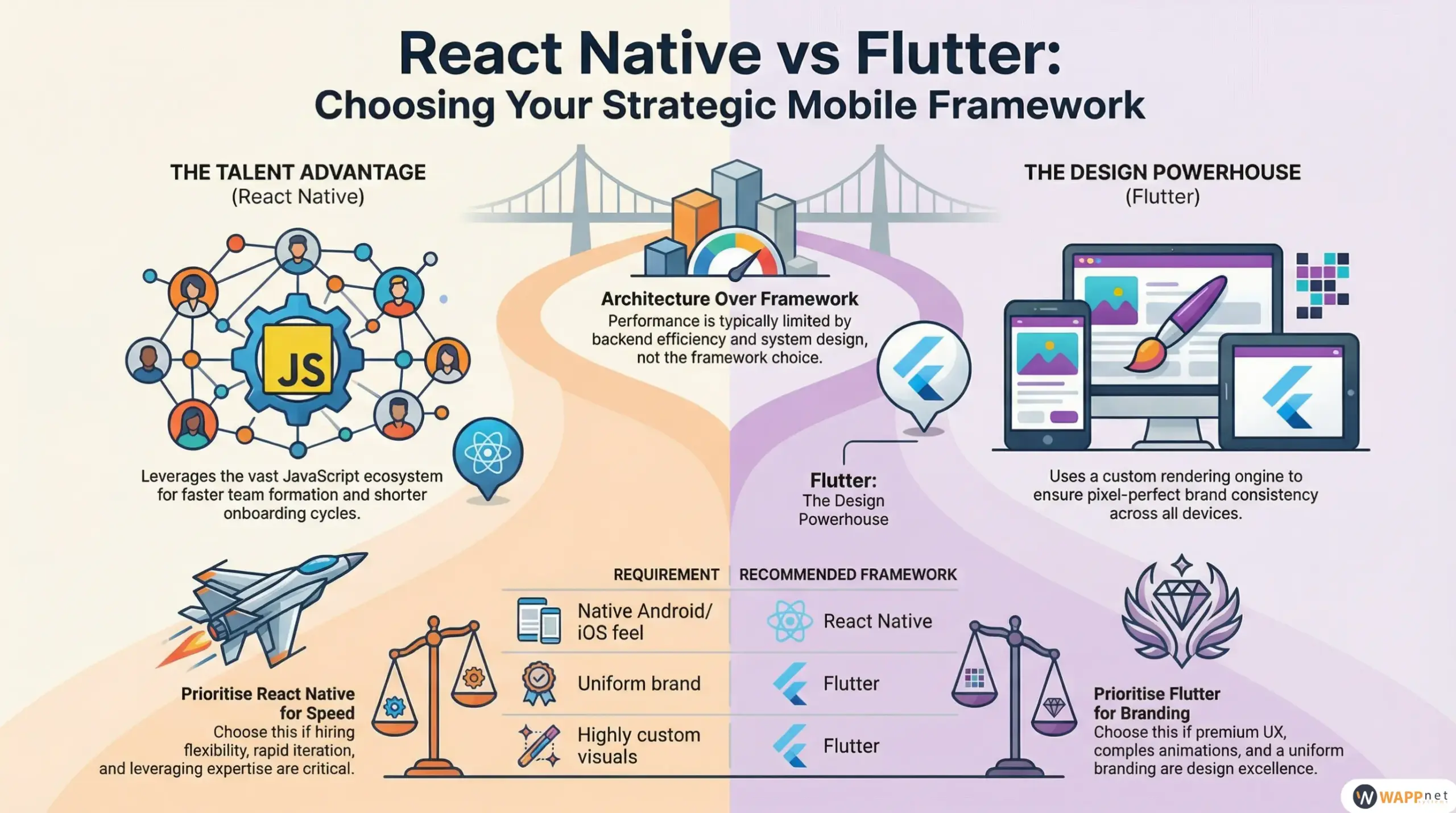
At times, there are exaggerations of differences online.
Practically, the majority of business applications are constrained by server performance, network performance, and data structure—and not the UI system.
The technologies are both very efficient in dashboards, e-commerce, booking systems, healthcare applications, and enterprise mobility tools.
The larger threat is a bad system structure rather than structural constraints.
Here is the place of positive contrast.
Flutter is good when you need all the devices to display the same visual identity. React Native is also excellent when the platform’s familiarity enhances user comfort.
You cannot say that either of them is better off in all cases; they prioritize other goals.
| Requirement | Better Fit |
| Native Android/iOS feel | React Native |
| Brand uniformity | Flutter |
| Highly custom visuals | Flutter |
| Faster default layouts | React Native |
Talent availability may affect delivery schedules as opposed to technical advantages.
React Native has access to the massive JavaScript ecosystem. The talent pool of Flutter is growing rapidly, yet it might need further specific recruitment in certain markets.
Budget is not just about building expense.
It includes:
If your company already runs React on the web, React Native may reduce initial investment. If visual customization dominates your roadmap, Flutter may reduce repeated redesign effort.
Cost Snapshot
| Cost Driver | Observation |
| Developer supply | React Native often easier |
| MVP speed | Both fast |
| Custom UI workload | Often lighter in Flutter |
| Long-term scalability | Architecture dependent |
Startups are characterized by prioritizing validation and speed.
They desire to experiment, change gears swiftly, and attract capitalists. React Native often matches these pressures since the teams can go quickly and recruit effectively.
Nevertheless, when the startup has high competition based on design innovation, Flutter can offer differentiation.
Businesses do not work like that. They seek governance, repeatability, and sustainability for many years.
Flutter might be desirable when it is necessary to have a common design language in numerous applications. React Native is still strong where the level of integration and availability of developers is supreme.
Practically, framework nuances tend to yield to architecture, DevOps, and security planning in the enterprise setting.
Both technologies are confirmed by large platforms.
As an example, Instagram relies on React Native to enhance productivity, whereas Alibaba can rely on Flutter to create large digital ecosystems.
Rather than posing the question of which framework is superior, pose the question of which one fits into your operating model.
Choose React Native if:
Choose Flutter if:
Many teams rush into development before defining:
These gaps create more damage than any framework limitation.
React Native vs Flutter is a contest with no favorable result.
The more intelligent thing to do is to consider the reality of hiring, the complexity of the roadmap, expected branding, and integration requirements. Both frameworks have the capacity to drive dependable, scalable, and future-ready applications with experienced architects and disciplined execution.
Most of the businesses that do not make decisions emotionally but in a strategic manner tend to have better ROI and minimal rebuilds.
Is Flutter faster than React Native?
Yes, in certain rendering cases, but in a majority of business apps, the framework is not the key factor in determining speed, but rather the underlying backend and architecture.
Which is cheaper, React Native or Flutter?
Depending on the availability of hiring, the complications of UI, and long-term maintenance strategies, costs vary.
What do startups usually choose?
Several startups tilt towards React Native because of quicker hiring; however, without design as their competitive advantage.
Can enterprises use React Native?
Absolutely. It is able to operate on numerous large systems successfully, provided with strong engineering practices.