Call us USA (+1)312-698-3083
| Email : sales@wappnet.com

The digital transformation today is being driven by cloud computing.As startups roll out scalable applications and enterprises re-engineer legacy systems, speed, flexibility, and innovation are now possible at a scale never seen before, using a cloud platform.
One of the comparisons that prevails when businesses consider adopting the cloud is AWS vs. Azure vs. GCP.Amazon Web Services (AWS), Microsoft Azure, and Google Cloud Platform (GCP) are the three service providers that have dominated the cloud market in most parts of the world and dictated the pace at which cloud computing services are offered across the globe.
Nonetheless, popularity is not the only factor when selecting the appropriate cloud provider.The platforms perform well in various aspects, which include scalability, integration with the enterprise, analytics, pricing, and AI capabilities. This guide provides an in-depth cloud platform comparison to enable decision-makers to realize the strong, weak, and usage abilities and prospective trends.
We unpack the AWS vs Azure vs GCP in this blog by service, price, security, performance, and business real-life examples- because you can now comfortably make a choice of the optimal cloud strategy to use within your organization.
Key Takeaways

Cloud platforms are on-demand computing resources, including servers, storage, databases, networking, analytics, AI tools, and so forth. Cloud computing services allow businesses to construct, launch, and expand applications more cost-effectively and economically, instead of maintaining physical infrastructure.
Key benefits of cloud platforms include:
The AWS, Azure, and GCP big 3 cloud platforms provide Infrastructure as a Service (IaaS), Platform as a Service (PaaS), and enhanced managed services used by millions of applications globally.
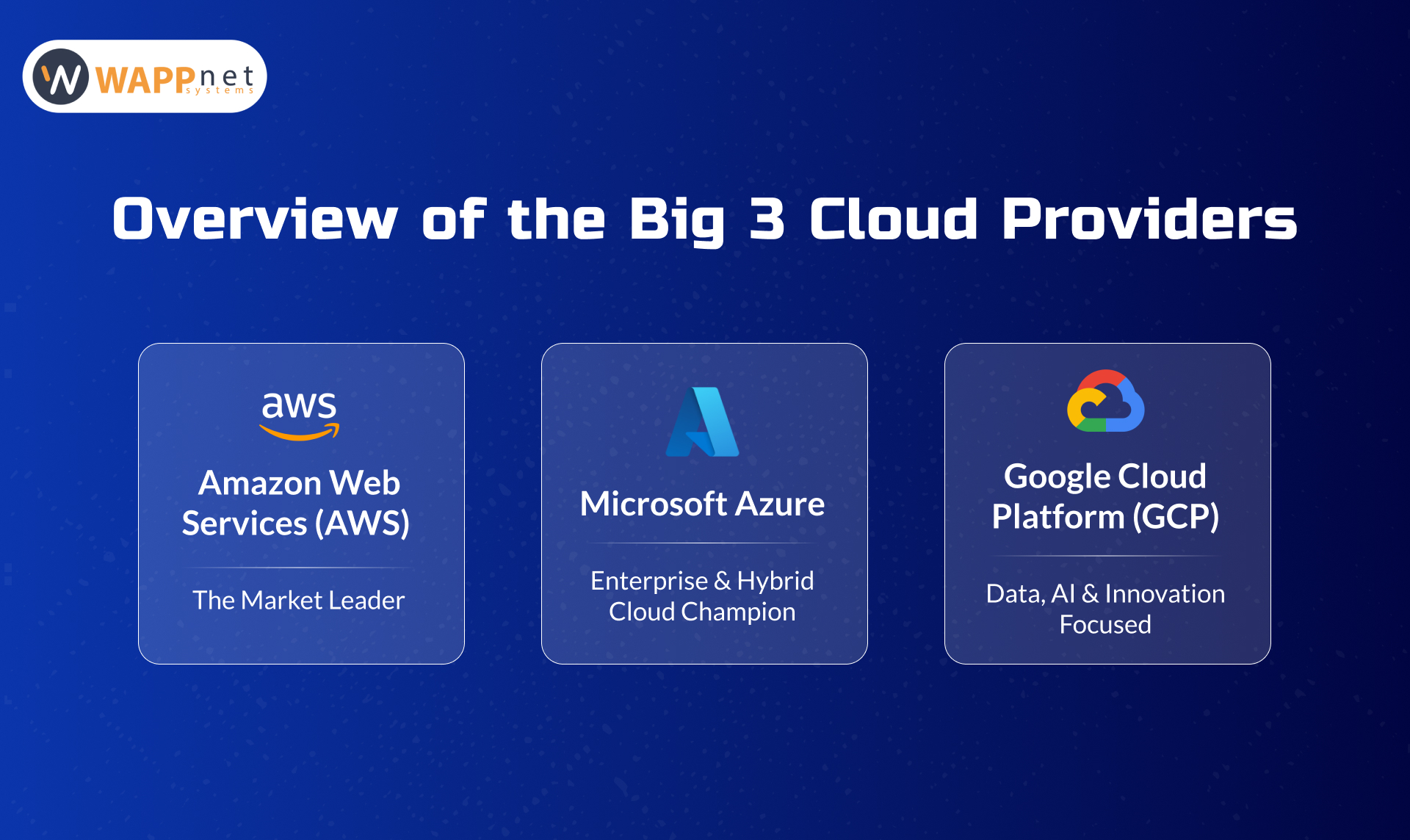
AWS was released in 2006 and is the oldest and most popular cloud platform everywhere in the world. It has the most comprehensive services and the biggest presence in infrastructure across the globe.
Key strengths of AWS:
Popular AWS services include:
AWS is often the first choice for startups, SaaS companies, and enterprises requiring flexibility and scale.
Microsoft Azure is fully compatible with the Microsoft ecosystem and can be an obvious option for those enterprises that use Windows Server, Active Directory, Microsoft 365, and SQL Server already.
Key strengths of Azure:
Popular Azure services include:
In the case of companies that are in the process of digital transformation, where they use old systems, the migration process with Azure is often the easiest one.
Google Cloud Platform has been associated with strengths in data analytics, artificial intelligence, as well as open-source technologies. Smaller, GCP is a favorite with data-driven and AI-first companies.
Key strengths of GCP:
Popular GCP services include:
GCP particularly excels in analytics-intensive workloads, real-time processing of data, and AI innovation.
Knowledge of cloud provider market share can be used to determine the maturity and adoption of the platform.
| Cloud Provider | Approx. Market Share | Key Advantage |
| AWS | ~32% | Broadest service portfolio |
| Azure | ~23% | Enterprise & hybrid cloud |
| GCP | ~11% | Data analytics & AI |
Source: Industry cloud market reports (Gartner, Synergy Research)
The cloud market is expanding at a tremendous rate, and multi-cloud and hybrid are very likely to be the standard approach of large organizations.
Core Cloud Services Comparison
| Feature | AWS | Azure | GCP |
| Compute | EC2 | Virtual Machines | Compute Engine |
| Storage | S3 | Blob Storage | Cloud Storage |
| Databases | RDS, DynamoDB | Azure SQL, Cosmos DB | Cloud SQL, Spanner |
| Containers | ECS, EKS | AKS | GKE |
| Serverless | Lambda | Azure Functions | Cloud Functions |
| AI/ML | SageMaker | Azure AI | Vertex AI |
This comparison of cloud services reveals that the core services of each platform are similar with the difference in performance, prices, and tooling.
One of the most complicated issues of AWS vs Azure vs GCP is pricing. Each of the three platforms is a pay-as-you-go system, with prices depending on the type of compute, storage, region, and usage patterns.
Key pricing insights:
| Pricing Aspect | AWS | Azure | GCP |
| Free Tier | Yes | Yes | Yes |
| Reserved Discounts | Yes | Yes | Sustained Use |
| Cost Management Tools | Strong | Strong | Very Strong |
The selection of the proper platform must be done after a thorough cost optimization planning and workload study.
All three platforms have a common responsibility of security. All the providers are significant in the standards and certifications on cloud security comparisons.
Common security features:
| Security Area | AWS | Azure | GCP |
| IAM | AWS IAM | Azure AD | Cloud IAM |
| Compliance | Extensive | Extensive | Extensive |
| Threat Detection | GuardDuty | Defender | Security Command Center |
The three platforms are fit for the highly regulated industries with a proper structure.
Read More: The Future of App Monetization: Subscription Alternatives & Web3 Models by 2026
The knowledge of cloud platform use cases will make sure that you match technology to business objectives.
The future of cloud computing is driven by:
With the changing nature of the platforms, businesses will be turning to cloud solutions as a way of running businesses that are focused on flexibility, intelligence, and automation.
There is no clear victor in the dispute over AWS vs Azure vs GCP. Both platforms have strong features, and the correct option will depend on the size of your organization, industry, workloads, and future objectives.
We provide cloud-based architecture design, migration, and optimization services to businesses at Wappnet. Regardless of whether you are embarking on your cloud journey or you need to optimize an existing system, having the correct cloud strategy is everything.
Expert cloud consulting at Wappnet.
Free cloud readiness assessment request.
Create a safe, high-scale, and future-proof cloud infrastructure.