Call us USA (+1)312-698-3083
| Email : sales@wappnet.com

Open-source technologies are still leading the innovation in software development, AI applications, and cloud infrastructure. These trends are not only limited to startups in 2026; they are also essential for enterprises that want to scale, ensure security, and accelerate innovation.
By implementing AI-driven open-source software, cloud-native frameworks, and secure DevOps applications, enterprises will be able to speed up the digital transformation and sustain a competitive advantage in the current fast-growing technical environment.
Key Takeaways

AI acceleration, cloud expansion, and built-in security for modern businesses.
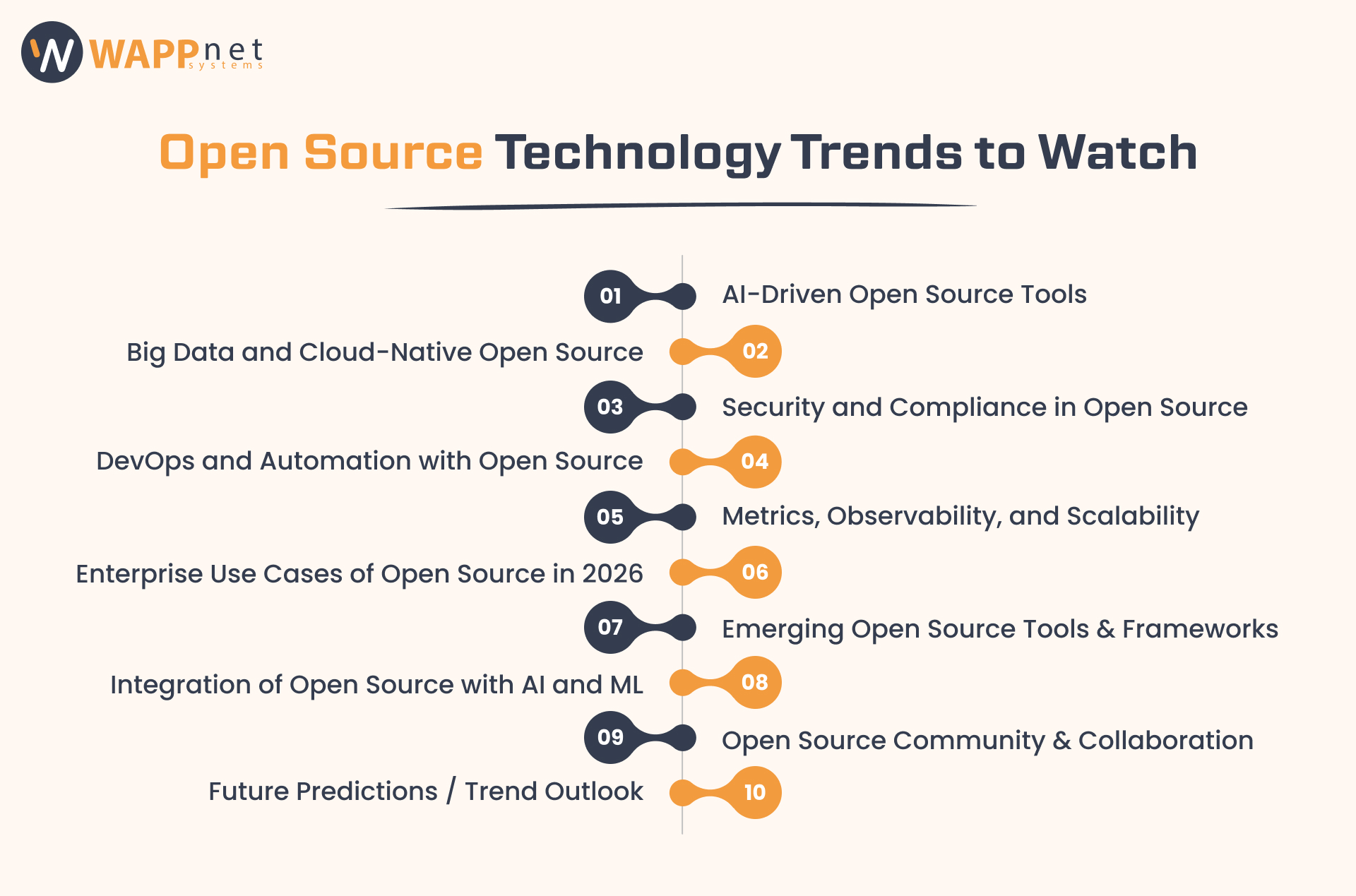
The concept of artificial intelligence is transforming open-source development. The use of frameworks such as TensorFlow, PyTorch, and Ray, and artificial intelligence-powered automation tools allows entering businesses to undertake forecasting analytics, smart automation, and live insights.
Enterprise decision-making requires Big Data. Open-source software, such as Apache Hadoop, Apache Spark, and Kubernetes, can be used to process big data efficiently.
The use of open-source continues to increase, yet so does the security issue. The weak security measures of tools such as OpenSSL and Log4j emphasize the importance of strong security measures.
Jenkins, GitLab CI/CD, Argo CD, and Terraform are open-source DevOps tools that can be used to automate, perform continuous integration, and perform continuous delivery.
This is because monitoring and metrics are vital as the business expands. Real-time observability is offered by such tools as Prometheus, Grafana, and ELK Stack.
| Industry | Open-Source Tools | Use Case | Key Benefit |
| Finance | TensorFlow, PyTorch, Apache Spark | Risk modeling, AI-driven fraud detection | Faster insights, accurate risk analysis |
| Healthcare | MLflow, Kubernetes, Apache Spark | Patient data analytics, scalable AI platforms | Improved healthcare outcomes, scalable AI solutions |
| E-commerce | TensorFlow, Ray, LangChain | Recommendation engines, personalized marketing | Enhanced customer experience, increased conversions |
| IT Infrastructure | Kubernetes, Docker, Terraform | Cloud-native deployments, automation | Scalable, reliable, and cost-effective infrastructure |
While AI, cloud-native, and automation tools continue to evolve, traditional development frameworks remain essential for enterprise applications. Many organizations continue to adopt Laravel as a leading open-source PHP framework for building secure, scalable, and high-performance web applications that integrate seamlessly with modern cloud environments.
| Tool / Framework | Purpose | Enterprise Benefit |
| LangChain & Ray | AI model orchestration, distributed computing | Simplifies ML workflows, scalable AI deployments |
| MLflow | ML lifecycle management | Faster experimentation to deployment |
| Argo Workflows & Kubernetes Operators | Cloud-native orchestration | Streamlines automation, supports scalable infrastructure |
AI and ML pipelines revolve around open-source platforms. Companies use TensorFlow, PyTorch, and Ray to process information, automate, and provide actionable insights.
Open-source is strong in terms of community contribution. Tools are enterprise-ready, as thousands of developers work on them to improve security, performance, and features.
There will be further adoption of open source. Business is going to embrace:
The 2026 trends in open-source technology revolve around the integration of AI, cloud-native, secure DevOps, and observability. Businesses that are able to take advantage of these trends become flexible, scalable, and competitive.
Lead the digital transformation process by implementing the modern open-source tools, AI frameworks, and security solutions. Visit our Open Source Web Development Services to apply these trends in your organization.